Remember the thrill of 3D in cinemas, those jaw-dropping moments when visuals seemed to leap off the screen? While 3D televisions largely faded from the mainstream, 3D projectors have quietly held their ground, offering a unique, immersive experience for home theater enthusiasts. But in 2026, with rapid advancements in 4K, HDR, and emerging VR technologies, are 3D projectors still a worthwhile investment for your entertainment setup? The answer is nuanced, depending heavily on your priorities and appetite for a truly distinct visual journey.
The Evolving Landscape of 3D Projectors
Projectors, at their core, transform digital data into a large-format image, bringing the cinematic experience home. Historically, 3D capabilities were a premium feature, allowing viewers to perceive depth and realism using specialized glasses. While the wider consumer market for 3D displays has dwindled, the niche of 3D projectors has persisted, catering to those who prioritize the depth effect over other cutting-edge features. This segment of the market isn’t as dynamic as its 2D counterpart, but it continues to offer dedicated solutions for those seeking that extra dimension.
Projector technology itself has seen significant evolution. Digital Light Processing (DLP) projectors often lead the pack for 3D, known for their fast response times that are crucial for rendering the sequential images required for active 3D. LCD (Liquid Crystal Display) projectors, while excellent for color accuracy, can sometimes struggle with the speed needed for flicker-free 3D. LED and Laser light sources are increasingly prevalent, offering longer lifespans, greater brightness, and consistent color performance, all of which benefit the generally darker experience of 3D viewing.
Key Factors for 3D Projector Selection
Choosing a 3D projector involves considering several factors that are vital for both 2D and 3D performance, with some aspects becoming even more critical for the latter. Understanding these elements will help you make an informed decision.
Brightness (Lumen): This is paramount for 3D projection. Wearing 3D glasses inherently reduces the amount of light reaching your eyes, making the image appear darker. A higher lumen count (ANSI lumens for brightness) is essential to compensate for this light loss, ensuring a vibrant and impactful 3D picture. For casual viewing in a dimly lit room, 2,000-2,500 lumens might suffice, but for a truly bright and immersive 3D experience, especially on larger screens, aiming for 3,000 lumens or more is highly recommended.
Resolution: While 4K projectors are the standard for high-end 2D viewing in 2026, 3D content often remains primarily in Full HD (1080p). Active 3D projectors can deliver full 1080p resolution to each eye, maintaining sharpness. However, passive 3D, while more comfortable, typically halves the vertical resolution, which can be noticeable on very large screens if the source is 1080p. Some 4K passive displays can achieve a full HD 3D image thanks to their higher native pixel count.
Contrast Ratio: A high contrast ratio is critical for both 2D and 3D, providing depth and detail in both bright and dark scenes. For 3D, good contrast helps differentiate foreground and background elements, enhancing the sense of dimensionality. Without it, the 3D effect can look flat or muted.
Refresh Rate: This factor is especially crucial for active 3D projectors. Active shutter glasses rapidly open and close, alternating views for each eye. To create a smooth, flicker-free 3D image, the projector needs a high refresh rate, typically 120Hz or higher, to display 60 frames per second to each eye. Lower refresh rates can lead to noticeable flicker, causing eye strain and a less enjoyable experience.
Throw Ratio: This determines the distance a projector needs to be from the screen to achieve a certain image size. Whether you need a short-throw, long-throw, or ultra-short-throw projector, ensure it fits your space and desired screen size, keeping in mind that the best 3D experience often comes from a large, expansive image.
Connectivity: Modern projectors should offer multiple HDMI 2.0 or 2.1 ports to support various sources like Blu-ray players, gaming consoles, and streaming devices. Wireless connectivity (Wi-Fi, Bluetooth) is also beneficial for smart features and audio routing.
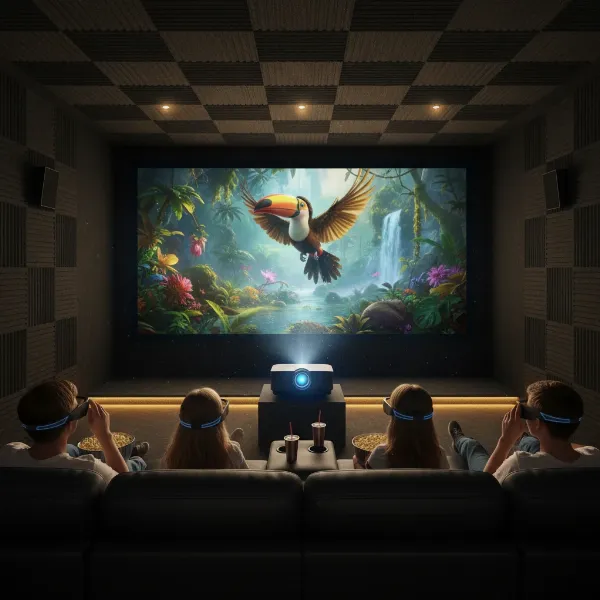 A modern home theater setup with a 3D projector displaying a vibrant image, a family wearing active 3D glasses watching a movie, dark room with subtle ambient lighting
Active vs. Passive 3D Projection: A Closer Look
The fundamental difference in 3D projection lies in how the image is delivered to each eye, leading to two main technologies: active and passive 3D. Each has distinct advantages and disadvantages that influence the viewing experience.
Active 3D Projectors
Active 3D technology utilizes battery-powered “shutter glasses” that rapidly alternate between opaque and transparent, synchronizing with the projector to show a slightly different image to each eye in quick succession. This creates the illusion of depth.
- Pros: The primary advantage is that each eye receives a full-resolution image (e.g., full 1080p), leading to a sharper and potentially more immersive experience. Active 3D projectors can also work with any standard white projector screen.
- Cons: The glasses are generally more expensive, require charging, and can be heavier. Some users may perceive flicker, especially in brighter scenes, or experience eye fatigue after extended viewing due to the rapid shuttering. The active glasses also darken the image, necessitating a brighter projector. Almost all new 3D-capable projectors utilize active 3D technology. [4, search result 3]
|
Our Picks for the Best projector in 2026
As an Amazon Associate I earn from qualifying purchases.
|
||
| Num | Product | Action |
|---|---|---|
| 1 | [Built-in Official Apps/4K Support] Smart Outdoor Projector with WiFi and Bluetooth, 800ANSI Movie Projector, DoIby Audio with Dual Speaker, Auto Focus w/ YouTube&PrimeVideo Proyector, Upgrad P62 Pro |
![Check [Built-in Official Apps/4K Support] Smart Outdoor Projector with WiFi and Bluetooth, 800ANSI Movie Projector, DoIby Audio with Dual Speaker, Auto Focus w/ YouTube&PrimeVideo Proyector, Upgrad P62 Pro on Amazon](https://projectorcam.com/wp-content/plugins/amazon-tables/assets/images/buy.png)
|
| 2 | 【Official Licensed Google TV】4K Smart Projector with WiFi and Bluetooth, VOPLLS Outdoor Projectors with Dolby/Auto Focus, Portable Movie Phone Wireless Gaming Wifi Proyector for Bedroom/Home/Celling |
|
| 3 | Aurzen Roku TV Smart Projector with Wifi and Bluetooth, Roku Streaming Experience Built-in, 1080P FHD, DoIby Audio, Auto Focus & Keystone, Zoom, Movie Portable Outdoor Mini Projector, White |
|
| 4 | 【Officially-Licensed APP & Native 1080P】Thinnest 1.81\" Smart Mini Projector with WiFi and Bluetooth, Auto Focus & Keystone Portable Outdoor Projector, VOPLLS 4K Support Home Movie Projector |
|
| 5 | Epson Pro EX11000 3-Chip 3LCD Full HD 1080p Wireless Laser Projector, 4,600 Lumens Color/White Brightness, Miracast, 2 HDMI Ports, USB Power for Streaming, Built-in 16W Speaker |
|
| 6 | HAPPRUN Native 1080P Bluetooth Mini Projector, Full HD Portable Outdoor Movie Projector with Built-in Speaker, Compatible with Smartphone, HDMI, USB, AV, Fire Stick, PS5 for Home, Bedroom, Outdoor Use |
|
| 7 | [3500 ANSI/ Official Apps/65W Audio] Outdoor 4K Projector with WiFi and Bluetooth, Auto Focus, Auto Keystone Smart Projector Support DoIby Audio, 2026 Upgrade GO2 Short Throw Projector with 360°Stand |
|
| 8 | Epson Pro EX9270 Wireless 1080p 3LCD Projector 4,100 Lumens Color and White Brightness, Apple AirPlay, Miracast, Stream from Phone or Laptop, 2 HDMI Ports, 1.6x Optical Zoom, Built-In Speaker |
|
| 9 | 1500 ANSI Official Licensed Google TV Smart Projector, HAPPRUN 4K Full HD Home Theater with Auto Focus, Dolby Sound, Wi-Fi Bluetooth, Built-in Apps, Compatible with Phone & PC, Indoor & Outdoor Use |
|
| 10 | Projector-4K with WiFi and Bluetooth:[3500 ANSI/60W Dolby Audio/Official Licensed Apps], Outdoor-Projector with Smart OS 2.0 & AI Auto Focus,ONOAYO ONO5Pro 2.0 Smart Movie Projector for Indoor/Outdoor |
|
Passive 3D Projectors
Passive 3D relies on polarized glasses, similar to those used in many commercial 3D cinemas. These glasses have differently polarized lenses that filter specific light waves from the projector, with each lens receiving a distinct image.
- Pros: Passive glasses are significantly cheaper, lighter, and don’t require batteries, making them more comfortable for extended viewing and ideal for larger groups. They are also less prone to flicker.
- Cons: The main drawback is that passive 3D typically halves the vertical resolution of the image when displaying 1080p content. While this effect is less noticeable on 4K projectors that can dedicate more pixels to each eye, it can impact sharpness on traditional 1080p systems. Passive 3D also requires a special silver-coated or polarized screen to maintain the polarization of the light, which can add to the overall cost. Passive 3D is less common in projectors compared to active 3D.
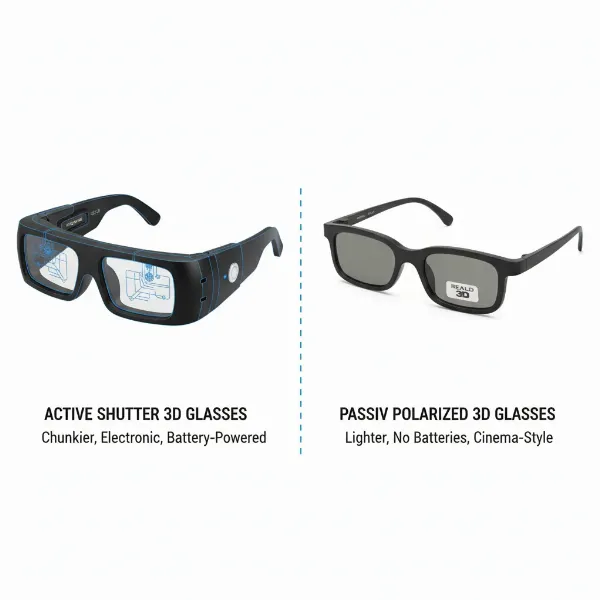 A comparison of active shutter 3D glasses and passive polarized 3D glasses, highlighting their design differences and technology.
The State of 3D Content in 2026
The availability of 3D content is perhaps the biggest consideration for anyone contemplating a 3D projector in 2026. While the hardware still exists, the content ecosystem has significantly shifted.
Streaming Services: Major streaming platforms like Netflix, Hulu, Disney+, and Prime Video largely do not offer 3D content. [4, search result 5] Streaming 3D content requires more bandwidth and processing power, and the waning demand for 3D TVs led many services to deprioritize it. Fandango at Home is one of the few platforms mentioned as still providing 3D movie rentals or purchases online. [1, search result 5]
Physical Media (3D Blu-ray): This remains the most reliable source for 3D movies. While major Hollywood studios have largely ceased new 3D Blu-ray releases in the US, hundreds of titles are still available, especially from international markets and boutique labels. [3, search result 5] For dedicated collectors, building a library of 3D Blu-rays is certainly possible, with some European distributors still releasing new 3D titles for Universal and Paramount films. [3, search result 5]
Gaming: Some projectors, like the BenQ TK700ST-i, are specifically marketed for 3D gaming, offering low input lag and high refresh rates crucial for an immersive and responsive gaming experience. [2, search result 5] While 3D gaming isn’t as prevalent as it once was, a dedicated setup can still offer a unique way to enjoy compatible titles.
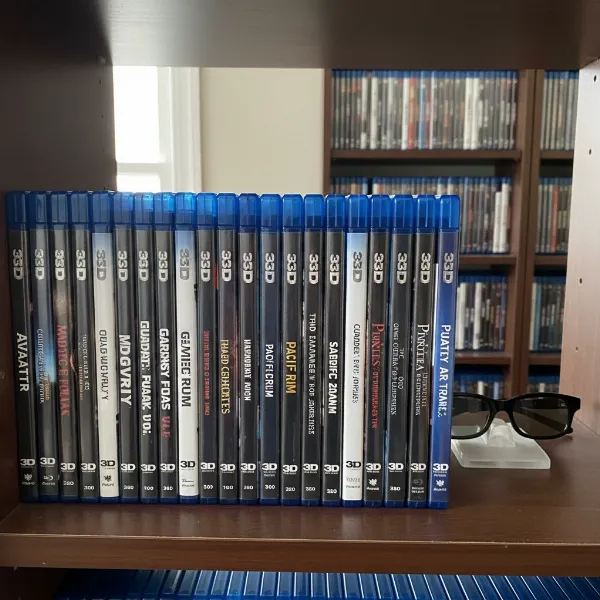 A collection of 3D Blu-ray movie cases on a shelf, hinting at physical media for 3D content in 2026.
Top 3D Projectors for 2026
Despite 3D being a niche, several projectors are still highlighted in 2026 for their 3D capabilities, often alongside their excellent 2D performance. Here are a few notable models that are frequently mentioned:
BenQ TK700ST-i
Recognized as a top choice for 3D gaming, the BenQ TK700ST-i is a 4K HDR projector designed for stunning visuals. It boasts a resolution of 3840×2160, ensuring sharp and clear details, complemented by 3,000 lumens of brightness for vibrant images even in moderately lit environments. Its ultra-low input lag of 4.16 milliseconds and high refresh rate of 240 hertz at 1080p make it ideal for fast-paced games, while its 3D compatibility ensures immersive viewing experiences. [2, search result 5]
BenQ HT2060
This high-performance Full HD home theater projector offers vibrant HDR10 and HLG support, delivering sharp 1080p visuals with deep contrast and rich color reproduction. It’s ideal for movies, games, and shows, featuring flexible setup options like vertical lens shift and 1.3x zoom, low input lag, dual HDMI 2.0 ports, built-in speakers, and strong 3D compatibility for immersive viewing. [2, search result 5]
BenQ AK700ST
Originally designed with golf simulation in mind, the BenQ AK700ST has been listed as a top 3D projector for watching movies. [3, search result 3] It offers cinematic-grade 4K DLP resolution (3840×2160) and a substantial 4000 ANSI lumens of brightness, ensuring high-quality visuals. Its laser technology and expert color calibration further enhance the picture quality. [3, search result 3]
Valerion VisionMaster Max
Highly recommended in 2025 and still relevant in 2026, the Valerion VisionMaster Max is a 4K DLP projector with 3500 lumens and a wide Rec.2020 color gamut. It aims to deliver intensely vibrant visuals with minimal rainbow effect and offers unparalleled color accuracy. [3, search result 3]
Optoma GT5500+ / GT2000HDR
Optoma frequently features in discussions about 3D projectors. The GT5500+ (and similar models like the GT2000HDR) combines practicality with powerful performance, making it a strong choice for gamers and cinephiles who want a large, impactful visual experience without compromising on space. [2, search result 5, 3, search result 3]
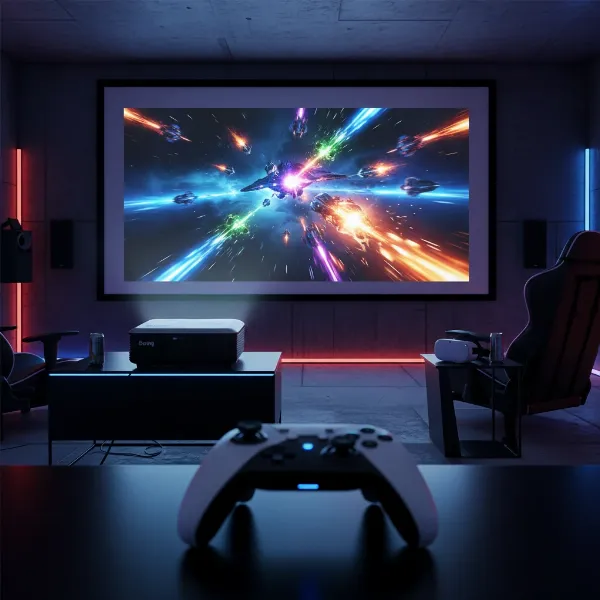 The BenQ TK700ST-i 3D gaming projector in action, projecting a dynamic game scene, with a gaming controller in the foreground.
Buying Guide: Deciding on a 3D Projector
If you’re considering a 3D projector in 2026, a thoughtful approach is key to ensuring your investment aligns with your expectations.
- Determine Your Core Need: Are you a dedicated enthusiast with a collection of 3D Blu-rays and a desire for the most immersive movie nights? Or are you a gamer looking for a unique way to experience compatible titles? If 3D is a secondary interest, a projector with excellent 2D performance and optional 3D might be a better fit.
- Assess Your Budget: 3D-capable projectors can range widely in price. Factor in the cost of high-quality glasses (especially active ones) and potentially a specialized screen for passive 3D.
- Evaluate Your Viewing Environment: A dark, light-controlled room is always best for projection, and it’s even more crucial for 3D to maximize brightness and contrast. Consider ambient light and screen size.
- Content is King: Seriously consider your primary sources for 3D content. If you’re relying on streaming, your options are extremely limited. A substantial collection of 3D Blu-rays or a strong interest in 3D gaming will justify the purchase.
- Consider Alternatives: For immersive experiences, modern Virtual Reality (VR) and Augmented Reality (AR) headsets offer incredibly compelling 3D environments, though typically for individual use. High-refresh-rate, large-format 4K HDR TVs and projectors also deliver stunning 2D visuals that many find sufficiently immersive without the need for glasses.
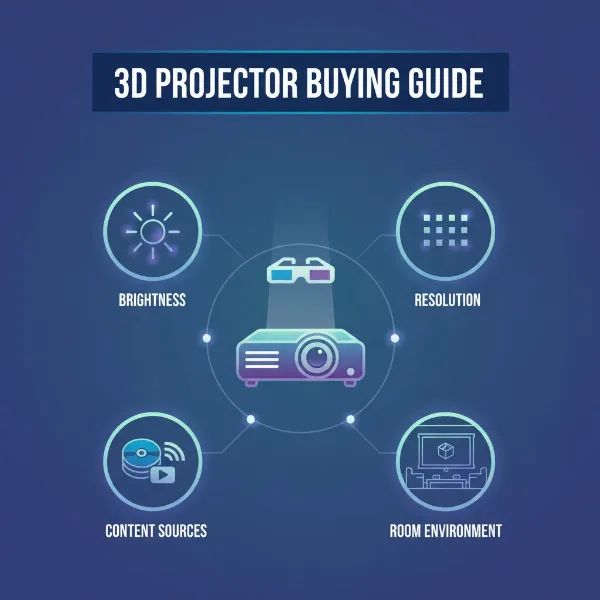 Infographic elements illustrating key factors to consider when buying a 3D projector, such as lumens, resolution, and content sources.
Tips for Optimizing Your 3D Projector Experience
Once you’ve acquired your 3D projector, a few tips can help you get the most out of your immersive setup.
- Screen Selection: For active 3D, a high-gain white screen can help boost brightness. For passive 3D, a silver or polarized screen is essential. Ensure your screen material enhances depth and reduces crosstalk.
- Calibration: Proper calibration of your projector’s brightness, contrast, and color settings can significantly improve both 2D and 3D image quality. Since 3D viewing darkens the image, you might need specific calibration profiles for 3D content.
- Seating Arrangement: Position yourself directly in front of the screen, ideally at a distance that fills your field of view without causing eye strain. This “sweet spot” minimizes potential ghosting or loss of effect, especially for passive 3D.
- Minimize Ambient Light: Even with a bright projector, ambient light can wash out the 3D effect. Make your viewing room as dark as possible to maximize contrast and immersion.
- Maintain Your Projector: Regular cleaning of the lens and filters, and ensuring adequate ventilation, will prolong your projector’s life and maintain optimal performance.
“While 3D isn’t for everyone, for those who truly appreciate the depth and spectacle it offers, a quality 3D projector can still deliver an unparalleled home cinema experience that TVs simply can’t match.”
Conclusion
In 2026, 3D projectors occupy a distinct niche. They are certainly still worth buying for dedicated home theater enthusiasts and gamers who cherish the unique immersive depth that 3D content provides. While the widespread availability of 3D streaming has diminished, a robust library of 3D Blu-rays and a selection of capable projectors ensure the format lives on for those willing to seek it out. If you prioritize the spectacular, glasses-on experience and are prepared to manage content sources, a 3D projector can still transform your living room into a truly captivating cinema.
Are you ready to take the plunge into the third dimension, or are your cinematic cravings satisfied with stunning 2D 4K visuals?
Frequently Asked Questions
Are 3D movies still being released in 2026?
While major Hollywood studios have largely stopped releasing 3D movies on physical media in the US, some international distributors continue to offer 3D Blu-rays for new titles. Furthermore, popular cinematic events, like “Avatar 3,” may still see 3D releases to cater to dedicated fans and specific cinema formats.
Do 4K projectors support 3D content?
Many modern 4K projectors are indeed 3D compatible, often utilizing active 3D technology. While native 3D content is typically 1080p, these projectors can upscale it, and their higher brightness and clarity can enhance the overall 3D viewing experience, making the image sharper even through glasses.
What kind of glasses do I need for a 3D projector?
Most 3D-capable projectors sold today use active 3D technology, requiring active shutter glasses that synchronize with the projector. These glasses are battery-powered and more expensive than passive glasses. If you opt for a passive 3D system, you’ll need specialized polarized glasses and a compatible screen.
Is 3D content available on streaming services like Netflix in 2026?
As of 2026, major streaming platforms such as Netflix, Hulu, Disney+, and Amazon Prime Video generally do not offer 3D content. The demand for 3D TVs declined, leading most streaming services to cease support for 3D. Fandango at Home is one of the few platforms where you might still find 3D movies for purchase or rental.