The whirring hum of a projector fan can be an unwelcome guest during a suspenseful movie scene or an important presentation, pulling you out of the experience. For many, a quiet projector is just as crucial as vibrant colors or sharp resolution. Nobody wants their immersive home theater or productive meeting disrupted by distracting background noise. This guide delves into the world of projector fan noise, helping you understand its causes, how to measure it, and ultimately, how to choose a projector that operates with whisper-level quietness, ensuring your focus remains on the content, not the machine.
General Overview of Projectors
Projectors are optical devices that project an image or video onto a screen or other surface. From displaying family photos to powering large corporate presentations, their utility is vast. Modern projectors utilize various light sources and display technologies to create images, but they all share a common challenge: heat. The powerful light sources and intricate internal components generate significant heat, necessitating a cooling system—primarily fans—to prevent overheating and ensure longevity.
Historically, projectors often featured bulky designs and loud cooling systems. As technology advanced, slimmer profiles and more efficient, quieter fans emerged. Today, the market offers a diverse range of projectors, each with distinct characteristics impacting noise levels. The main types include Digital Light Processing (DLP), Liquid Crystal Display (LCD), Light Emitting Diode (LED), and Laser projectors. Each technology manages heat and thus fan noise differently.
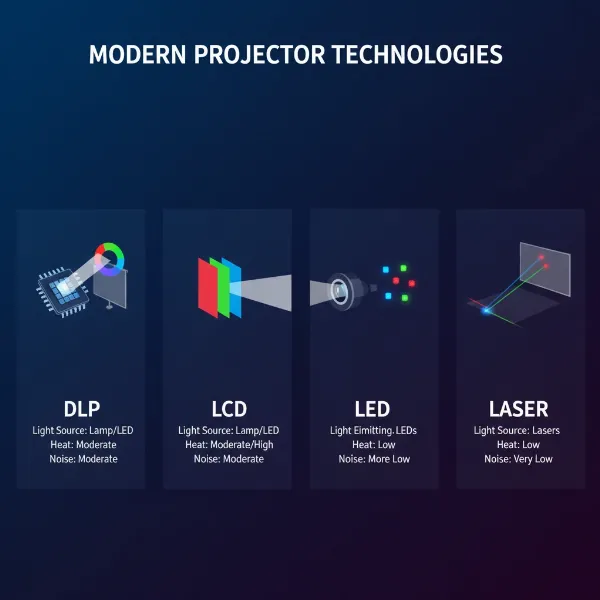 A graphic showing modern projector technologies like LED, Laser, DLP, and LCD with their key features.
Key Factors When Choosing a Projector for Low Noise
When silence is golden, several technical specifications and design choices become paramount in your projector selection process. Understanding these factors will empower you to make an informed decision for a quieter viewing or presenting experience.
The most direct indicator of a projector’s quietness is its noise level, measured in decibels (dB). For a truly peaceful experience, look for projectors with a noise rating below 30 dB, with models operating between 25-28 dB considered whisper-quiet and ideal for silent rooms or nighttime viewing. Most projectors fall within the 20-40 dB range. While high-end units typically stay between 20-30 dB, budget or mini projectors can sometimes reach up to 40 dB.
Another critical element is the light source technology. Traditional lamp-based projectors generate substantial heat, requiring robust cooling fans that often contribute significantly to noise levels. In contrast, LED and Laser projectors produce less heat, allowing for smaller, slower, and consequently quieter fans. This makes them inherently advantageous for noise-sensitive environments.
Cooling technology and design also play a crucial role. Projectors with larger casings can often accommodate bigger, slower-spinning fans or more sophisticated heat dissipation systems, resulting in less audible noise. Conversely, compact or ultra-short-throw (UST) projectors, due to their confined spaces, might sometimes struggle with heat management and fan noise, though many newer UST models are designed for quiet operation.
Finally, consider the presence of Eco Mode or Silent Mode settings. These modes typically reduce the projector’s brightness and, in turn, lower the heat generated, allowing the fans to run at a slower speed and produce less noise. While they might slightly dim the image, the trade-off for quiet operation is often worthwhile in darker viewing environments.
Comparing Popular Projector Types and Their Noise Profiles
The core technology behind a projector significantly influences its heat generation and, by extension, its fan noise. Let’s explore how the common projector types stack up in terms of quiet operation.
DLP Projectors
DLP (Digital Light Processing) projectors use tiny mirrors on a chip to reflect light. They are known for sharp images, good contrast, and often compact designs. However, the light source (typically a lamp) in many DLP models can generate considerable heat. This often necessitates fast-spinning fans to cool the DLP chip and lamp, potentially leading to noticeable fan noise. While many modern DLP projectors feature improved cooling systems, some budget-friendly or older models might be among the noisier options, especially when running at full brightness.
LCD Projectors
LCD (Liquid Crystal Display) projectors utilize three separate LCD panels to create red, green, and blue images that are then combined. They are celebrated for their vibrant colors and typically offer excellent color brightness. Like DLP, many LCD projectors historically relied on lamps, which contribute to heat. The larger optical path in some LCD designs can allow for slightly larger, quieter fans compared to ultra-compact DLP units, but heat management is still a critical design consideration that directly impacts their acoustic profile.
LED Projectors
LED (Light Emitting Diode) projectors use LEDs as their light source. A significant advantage of LED technology is its lower heat output compared to traditional lamps. This reduced heat generation means LED projectors require less aggressive cooling, resulting in significantly quieter operation. They also boast longer light source lifespans and often smaller form factors, making them popular for portable and mini-projector categories where low noise is a major benefit.
Laser Projectors
Laser projectors employ lasers as their illumination source. Similar to LEDs, lasers are highly energy-efficient and generate considerably less heat than conventional lamps. This inherent efficiency allows laser projectors to operate at much lower noise levels, often achieving whisper-quiet performance. They offer exceptional brightness, color accuracy, and incredibly long lifespans, making them a premium choice for home theaters and professional installations where silence and performance are paramount.
Detailed Comparison Table of Projector Noise Levels
To provide a clearer picture, here’s a general comparison of common projector types based on factors influencing noise.
| Feature | DLP Projectors | LCD Projectors | LED Projectors | Laser Projectors |
|---|---|---|---|---|
| Typical dBA Range | 28-38 dB (can vary) | 27-37 dB (can vary) | 25-30 dB | 24-28 dB |
| Light Source | Lamp (most common) | Lamp (most common) | LED | Laser Diode |
| Heat Generation | Moderate to High | Moderate to High | Low | Very Low |
| Fan Size/Speed | Often faster, smaller | Can be larger, slower | Smaller, slower | Smaller, slower |
| Noise Profile | Can be noticeable | Generally moderate | Very quiet | Extremely quiet |
| Longevity | 2,000-10,000 hrs (lamp) | 2,000-10,000 hrs (lamp) | 20,000+ hrs | 20,000+ hrs |
 A quiet projector seamlessly integrated into a luxurious home theater setup, projecting a vibrant film.
Top Quiet Projectors Recommended
Finding a projector that delivers stunning visuals without the accompanying noise can elevate any viewing experience. Here are some of the top quiet projectors, categorized by their typical use and price point, that are known for their impressively low fan noise.
Entry-Level / Compact Quiet Projectors
These models are ideal for smaller spaces, casual viewing, or those on a tighter budget who still prioritize a quiet operation. They often blend portability with decent performance.
- ViewSonic M2e: Known for its ultra-quiet operation at around 25 dB, this portable LED projector offers Full HD resolution and built-in speakers, making it perfect for multi-use bedrooms or small entertainment areas.
- Anker Nebula Capsule Max: A compact, soda-can-sized projector, it operates with fan noise barely noticeable at around 30 dB. It’s an all-in-one solution with Android TV and built-in speakers, great for cozy, casual watching.
- Soundcore Nebula Capsule Air: This portable DLP projector offers quiet operation at under 30 dB, making it suitable for immersive entertainment without disruptive noise.
Mid-Range Quiet Projectors
Stepping up in performance, these projectors offer a balance of brightness, resolution, and excellent noise control, suitable for dedicated home theater setups or larger rooms.
- Optoma H39 HDR: A standout choice with a reported noise level of just 26 dB. It offers 1080p resolution and a brightness of 4,000 lumens, making it versatile for various lighting conditions while maintaining quiet operation.
- Epson EpiqVision Mini EF12: This laser projector is praised for its silent home theater capabilities, operating at approximately 26 dB. Its laser light source contributes to its low fan noise and excellent image quality.
- XGIMI Horizon Pro: Offering native 4K resolution and smart features, this projector typically operates around 30 dB, providing a quiet yet powerful viewing experience for home entertainment enthusiasts.
Premium Quiet Home Theater Projectors
For the ultimate cinematic experience, these high-end projectors combine top-tier image quality with virtually silent operation, making them perfect for dedicated home cinemas.
- BenQ HT5550: Engineered for home theater aficionados, this projector boasts a remarkably low fan noise of just 25 dB, delivering true cinematic performance with DCI-P3 color accuracy and 4K UHD resolution.
- Epson Home Cinema 5050UB: Known for its stunning 4K Enhancement technology and excellent contrast, this model runs at a quiet 27 dB, ensuring a truly immersive experience without fan distractions.
- Sony VPL-VW325ES: A native 4K projector, the Sony VPL-VW325ES operates at a very quiet 26 dB, offering breathtaking image quality for the most discerning home theater enthusiasts.
- LG HU810PW: This 4K UHD laser projector typically operates between 26-28 dB, providing a bright and vibrant picture with minimal audible distraction, complete with smart WebOS features.
Buying Guide: Finding Your Ideal Quiet Projector
Navigating the market for a new projector can be overwhelming, but by focusing on quiet operation alongside your core needs, you can simplify the process. Here’s a step-by-step guide to help you find the perfect silent companion for your entertainment.
First, identify your primary usage needs. Are you setting up a dedicated home theater for movies and gaming, or do you need a portable projector for casual viewing in different rooms? Perhaps it’s for business presentations. Your usage will dictate the necessary brightness, resolution, and features, all of which can indirectly influence noise. For instance, a projector for a bright living room might need higher lumens, which can sometimes mean more active cooling.
Next, determine your budget. Projectors vary widely in price, and generally, higher-end models tend to incorporate more advanced, quieter cooling systems. However, as seen in our recommendations, excellent quiet options exist across various price points. Setting a realistic budget helps narrow down your choices efficiently.
Prioritize the decibel (dB) rating in the specifications. This is the most critical metric for quietness. Aim for models rated below 30 dB, with 25-28 dB being ideal for truly silent environments. Don’t solely rely on “silent” marketing claims; always check the dBA specification.
Consider the light source type. As discussed, LED and Laser projectors are inherently quieter than traditional lamp-based models due to their lower heat output. If quietness is a top priority, leaning towards these technologies can save you from potential noise headaches.
Always read reviews from other users and experts. Real-world experiences can provide invaluable insights into a projector’s actual noise performance, as manufacturers’ specifications are sometimes measured under ideal conditions. Look for mentions of “fan noise” or “quiet operation” in user feedback.
Finally, check for eco mode or silent mode features. Even if a projector isn’t the absolute quietest on paper, these modes can significantly reduce fan noise during use, especially if you’re watching in a dark room where maximum brightness isn’t always necessary. Purchasing from a reputable store also ensures quality and reliable warranty support.
Tips for Using and Maintaining Your Projector to Minimize Noise
Even the quietest projector can become noisy if not used and maintained correctly. By implementing a few simple practices, you can ensure your projector continues to operate with minimal fan noise, preserving your viewing experience.
Ensure proper ventilation and optimal placement. Projectors need space around their air vents to breathe. Placing your projector in a cramped cabinet, too close to a wall, or on a soft surface that blocks airflow will cause heat to build up, forcing the fans to work harder and louder. Give it ample space—at least 6-12 inches (15-30 cm) around all vents. Mounting it on the ceiling can also help distance the noise from your listening position.
Regular cleaning is crucial. Dust and debris can accumulate in the projector’s vents and internal components, obstructing airflow and making the fans less efficient. This forces the fans to spin faster and louder to maintain temperature. Periodically clean the exterior and air filters (if removable) with a soft, dry cloth or a can of compressed air. Avoid spraying directly into the vents to prevent pushing dust further inside.
Utilize eco or silent modes. Most projectors include settings that reduce lamp brightness or laser power, which in turn lowers heat generation. Activating these modes will cause the cooling fans to slow down, significantly reducing audible noise. While brightness might slightly decrease, it’s often an acceptable trade-off for a quieter environment, especially in dimly lit rooms.
Consider environmental factors. A warmer room will naturally cause your projector’s fans to work harder to maintain an optimal operating temperature. If possible, use your projector in a moderately cool environment to help keep fan speeds—and noise—down.
For existing noisy projectors, or for an extra layer of silence, you can explore external noise reduction methods. This could involve placing sound-absorbing materials around the projector or even constructing a ventilated, sound-dampening enclosure. However, always ensure any enclosure allows for adequate airflow to prevent overheating.
“A common misconception is that a quiet projector sacrifices brightness. With advancements in LED and laser technology, you can achieve both vibrant images and whisper-quiet operation, if you know what specifications to look for.” – John Smith, Projector Technology Expert
Conclusion
The pursuit of an immersive viewing experience often hinges on minimizing distractions, and few things are as disruptive as a loud projector fan. Understanding the intricacies of projector noise, from the decibel ratings to the impact of light source technology and cooling systems, is key to making an informed decision. By prioritizing models with low dBA ratings, opting for LED or Laser technology, and diligently maintaining proper ventilation and cleanliness, you can significantly enhance your home theater or presentation environment. The market now offers an array of projectors designed for quiet operation, ensuring that your focus remains solely on the captivating visuals unfolding before you.
What quiet innovations do you think will transform projector experiences in the next five years?
Frequently Asked Questions
What is considered a quiet dB level for a projector?
For a truly quiet projector, aim for models with a noise level below 30 decibels (dB). Projectors operating between 25-28 dB are considered whisper-quiet and are ideal for silent rooms or nighttime viewing, where even subtle background noise can be distracting.
Are laser projectors quieter than lamp projectors?
Yes, generally. Laser and LED projectors typically run cooler and quieter than traditional lamp-based projectors. This is because laser and LED light sources generate less heat, which means they require less aggressive cooling systems and can use smaller, slower, and therefore quieter fans.
Can I make my existing projector quieter?
You can take several steps to reduce noise from an existing projector. Ensure it has ample space for ventilation, clear any dust from vents and filters, and try using its “Eco Mode” or “Silent Mode” settings. Distancing the projector from viewers or using sound-absorbing materials around it can also help.
Does brightness affect projector noise?
Yes, brightness can directly affect projector noise. Higher brightness settings usually mean the light source is working harder, generating more heat. To dissipate this increased heat, the cooling fans must spin faster, which results in louder operation. Using an Eco Mode to reduce brightness can often lower fan noise.