Have you ever settled in for a movie night, only to notice fleeting flashes of red, green, and blue appearing around objects on your projector screen? This often-distracting visual phenomenon is known as the “Rainbow Effect,” or RBE, and it’s a topic frequently discussed in the world of projection technology. While it can be a minor annoyance for some, it can significantly impact the viewing experience for others, even causing discomfort or headaches.
In this comprehensive guide, we’ll demystify the rainbow effect on DLP projectors. We’ll explore what it is, delve into the technical reasons behind its occurrence, identify factors that make it more noticeable, and compare how different projector technologies handle color. Most importantly, we’ll provide practical strategies and insights to help you minimize or even entirely avoid this optical artifact, ensuring a more immersive and enjoyable home theater experience.
Understanding DLP Projectors and the Rainbow Effect
To truly grasp the rainbow effect, it’s essential to first understand the core technology behind Digital Light Processing (DLP) projectors. Unlike other projector types that display all primary colors simultaneously, most single-chip DLP projectors employ a unique method for color generation.
At the heart of a single-chip DLP projector is a Digital Micromirror Device (DMD) chip, an array of millions of tiny mirrors that tilt rapidly to create the image. To add color to this image, these projectors typically use a spinning color wheel. This wheel is segmented with red, green, and blue (and sometimes yellow, cyan, or white) filters. As the color wheel rotates at high speed, it sequentially flashes each primary color onto the DMD chip. The mirrors then reflect the corresponding colored light onto the screen in rapid succession. 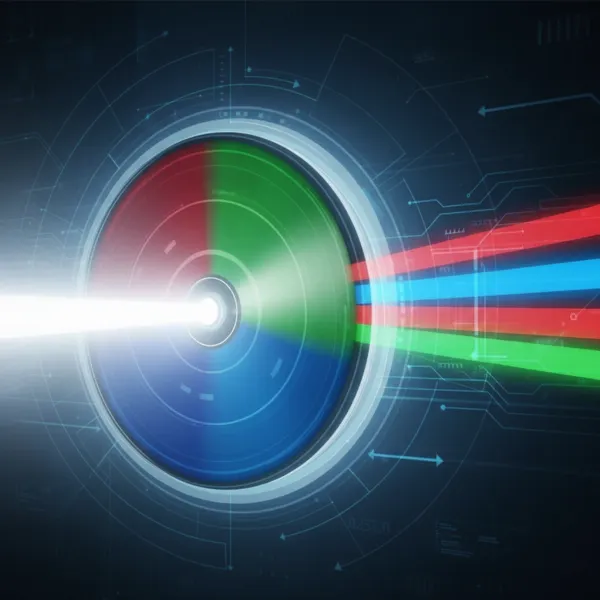 A conceptual illustration of a DLP projector's spinning color wheel with red, green, and blue segments, emphasizing sequential color display.
The projector displays these individual colored images so quickly that your brain is designed to blend them together, perceiving a single, full-color picture. However, for some individuals, especially when their eyes move quickly across the screen or during high-contrast scenes, this rapid sequential display can cause a “brain glitch.” Instead of a smoothly blended image, they briefly perceive the individual red, green, and blue flashes, creating the distinctive rainbow-like trails or “color breakup” that defines the rainbow effect.
Factors Contributing to the Rainbow Effect’s Visibility
The intensity and frequency of seeing the rainbow effect can vary greatly depending on several factors, ranging from the projector’s internal mechanics to the viewer’s own visual sensitivity and viewing habits.
A primary determinant is the color wheel speed within the DLP projector. Projectors with slower color wheels (often designated as 2x speed) present the sequential colors for a longer duration, increasing the likelihood of the brain perceiving the individual flashes. Conversely, projectors equipped with faster color wheels (4x, 6x, or even multi-segment RGBRGB wheels) reduce this visible separation by cycling through colors much more rapidly. This faster refresh rate gives the brain less opportunity to “catch” the individual color components.
Viewer sensitivity is perhaps the most significant and subjective factor. Not everyone experiences the rainbow effect, and among those who do, the degree of distraction varies wildly. Some individuals are highly sensitive, finding the effect very noticeable, distracting, and sometimes even leading to eye strain or headaches. Others may only perceive it faintly during specific scenes, or not at all. Research suggests that a notable portion of the population—around 40%—can detect these rainbow artifacts.
Certain content characteristics also play a crucial role. The rainbow effect tends to be most noticeable during:
- High-contrast scenes: Images with very bright objects against dark backgrounds (e.g., white text on a black screen, stars in a night sky, or a candle flame in a dark room) often highlight the color separation.
- Fast-moving objects or camera pans: When objects move rapidly across the screen, or the camera itself pans quickly, the sequential color display is more likely to break apart in the viewer’s perception.
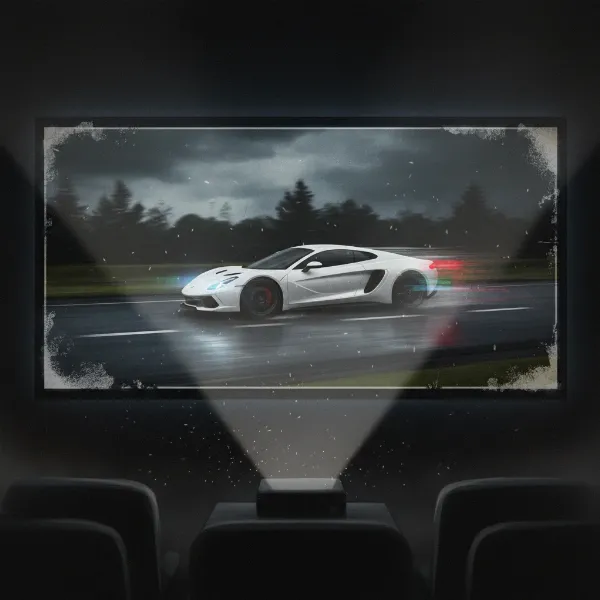 An illustration depicting the rainbow effect on a projector screen, showing subtle red, green, and blue fringes around a moving white object against a dark background, indicating visual discomfort.
Finally, viewing habits can influence how prominent the effect appears. Rapid eye or head movements while watching can inadvertently cause the eye to “scan” across the sequentially projected colors, making the rainbow trails more apparent.
Comparing Projector Technologies: DLP vs. LCD/LCoS Regarding Rainbow Effect
Understanding how other projector technologies handle color display is key to recognizing why the rainbow effect is almost exclusively a DLP-specific concern.
As discussed, single-chip DLP projectors inherently rely on sequential color display, whether through a spinning color wheel or rapid flashing from a solid-state light source. This fundamental mechanism is what makes them susceptible to the rainbow effect for sensitive viewers.
In contrast, 3-chip DLP projectors operate on a different principle. These high-end, often professional-grade, projectors utilize three separate DMD chips—one for each primary color (red, green, and blue). This architecture allows all three colors to be displayed simultaneously, completely eliminating the need for a sequential color wheel and, consequently, rendering them immune to the rainbow effect.
Similarly, LCD (Liquid Crystal Display) and LCoS (Liquid Crystal on Silicon) projectors are also inherently “rainbow-free.” These technologies use three separate display panels, each dedicated to projecting one of the primary colors (red, green, and blue) at the same time. Because the colors are merged before reaching your eyes, there is no sequential flashing to perceive, thus preventing any rainbow artifacts. 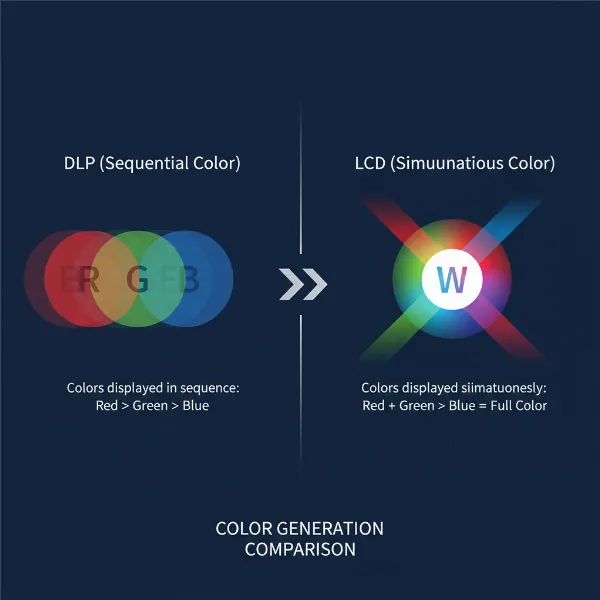 A split image comparing color display methods: one side showing sequential R-G-B flashes (DLP) and the other showing all three colors simultaneously (LCD), illustrating the difference in technology.
Detailed Comparison: Rainbow Effect Incidence Across Projector Types
To offer a clearer perspective, here’s a comparative overview of how different projector technologies fare concerning the rainbow effect:
| Projector Type | Color Display Method | Rainbow Effect Incidence | Notes |
|---|---|---|---|
| Single-Chip DLP | Sequential (Color Wheel) | Moderate to High | Varies by color wheel speed, segments, and viewer sensitivity. More noticeable in older or budget models. |
| 3-Chip DLP | Simultaneous | None | Premium, professional-grade. Utilizes three dedicated DMD chips. |
| LCD | Simultaneous | None | Uses three separate LCD panels for each primary color. |
| LCoS | Simultaneous | None | High-end technology with excellent contrast, also uses three panels. |
| LED/Laser DLP | Sequential (Fast Flashing) | Low to None | Solid-state light sources can switch colors much faster than physical wheels, significantly reducing RBE. |
Minimizing the Rainbow Effect: Recommended Projectors and Strategies
If the rainbow effect concerns you, or if you’ve experienced it previously, several options are available to minimize its impact or avoid it entirely.
Modern DLP Projectors with Reduced RBE
Thanks to continuous innovation in projector technology, the rainbow effect is becoming less prevalent and less noticeable in contemporary DLP models. Manufacturers have made significant advancements:
- Faster Color Wheels: Many newer single-chip DLP projectors boast higher color wheel speeds (e.g., 4x or 6x speed, referring to how many times per frame the full color sequence is displayed), which greatly reduces the time lag between colors.
- Multi-segment Color Wheels: The use of more segments in the color wheel, such as RGBRGB (red-green-blue repeated), also helps by increasing the refresh rate of individual colors.
- Solid-State Light Sources: Projectors utilizing LED or RGB Laser light sources often eliminate the physical color wheel altogether. While they may still display colors sequentially, their ability to switch between colors at extremely high frequencies effectively minimizes or virtually eradicates the rainbow effect for most viewers. Modern RGB Triple Laser projectors, in particular, are often lauded for being virtually free of this artifact.
|
Our Picks for the Best projector in 2026
As an Amazon Associate I earn from qualifying purchases.
|
||
| Num | Product | Action |
|---|---|---|
| 1 | [Officially-Licensed App & Auto Focus]Smart Mini Projector with WiFi and Bluetooth, XuanPad 4K Support Movie Projector, Portable Native 1080P Outdoor Projector with 360° Stand |
![Check [Officially-Licensed App & Auto Focus]Smart Mini Projector with WiFi and Bluetooth, XuanPad 4K Support Movie Projector, Portable Native 1080P Outdoor Projector with 360° Stand on Amazon](https://projectorcam.com/wp-content/plugins/amazon-tables/assets/images/buy.png)
|
| 2 | Projector-4K with WiFi and Bluetooth:[3000 ANSI/40W Dolby Audio/Official Licensed Apps], Outdoor-Projector with Smart OS 2.0 & AI Auto Focus,ONOAYO ONO5Pro 2.0 Smart Movie Projector for Indoor/Outdoor |
|
| 3 | Magcubic Mini Projector with WiFi 6 and Bluetooth 5.4, Portable Projector 4K Support, 5W Soundbase Speaker, Auto Vertical Keystone 180°Rotatable Smart Proyector for Movie Home Outdoor |
|
| 4 | [Built-in Official Apps/4K Support] Smart Outdoor Projector with WiFi and Bluetooth, 800ANSI Movie Projector, DoIby Audio with Dual Speaker, Auto Focus w/ YouTube&PrimeVideo Proyector, Upgrad P62 Pro |
|
| 5 | HAPPRUN Native 1080P Bluetooth Mini Projector, Full HD Portable Outdoor Movie Projector with Built-in Speaker, Compatible with Smartphone, HDMI, USB, AV, Fire Stick, PS5 for Home, Bedroom, Outdoor Use |
|
| 6 | Aurzen Roku TV Smart Projector with Wifi and Bluetooth, Roku Streaming Experience Built-in, 1080P FHD, Dolby Audio, Auto Focus & Keystone, Zoom, Movie Portable Outdoor Mini Projector, White |
|
| 7 | Mini Smart Projector, 1500 ANSI Portable Projector with WiFi and Bluetooth, HAPPRUN 4K Full HD Home Theater with 270° Stand, Dolby Sound, Built-in Apps,Compatible with Phone & PC, Indoor & Outdoor Use |
|
| 8 | 【Officially-Licensed APP & Native 1080P】Thinnest 1.81\" Smart Mini Projector with WiFi and Bluetooth, Auto Focus & Keystone Portable Outdoor Projector, VOPLLS 4K Support Home Movie Projector |
|
| 9 | Astronaut Galaxy Projector with Bluetooth Speaker & White Noise, App & Remote Control Star Projector, Galaxy Projector for Bedroom Adults Kids, Spaceman Night Light for Gaming Room, Home Theater |
|
| 10 | Mini Projector with Built-in Rechargeable Battery for Outdoor, Portable Projector with WiFi and Bluetooth, 4K Projector for Bedroom, Smart Projector |
|
Alternatives for Sensitive Viewers
For individuals who are highly sensitive to the rainbow effect, or who experience discomfort even with advanced single-chip DLP projectors, the most reliable solution is to opt for technologies that inherently avoid sequential color display:
- 3LCD Projectors: These are an excellent choice for home use, offering vibrant colors and a rainbow-free viewing experience at various price points.
- LCoS Projectors: Often found in higher-end home theater setups, LCoS technology provides exceptional contrast and a smooth, artifact-free image.
- 3-Chip DLP Projectors: While typically more expensive and geared towards professional or high-end custom installations, these are the ultimate rainbow-free DLP option.
Buying Guide: Navigating DLP Projectors and the Rainbow Effect
Choosing the right projector involves weighing various factors, and for some, the rainbow effect will be a critical consideration.
First and foremost, know your sensitivity. If you suspect you might be susceptible to RBE, try to test projectors in person. Visit a local electronics store or a dedicated home theater showroom to see different models in action. Pay attention during high-contrast scenes or when moving your eyes across the screen. If purchasing online, always check the retailer’s return policy.
When evaluating single-chip DLP projectors, inquire about the color wheel speed or the type of light source. Look for models with higher “x” speeds (e.g., 4x or 6x) or those that employ LED or laser illumination, as these are typically designed to minimize RBE. 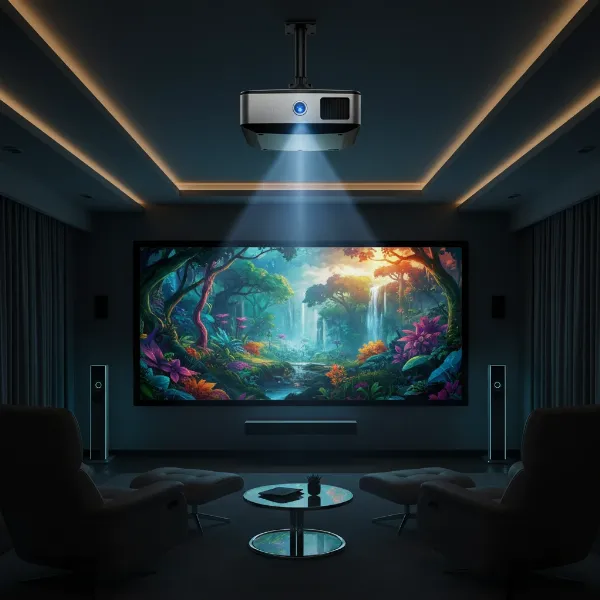 A sleek, modern DLP projector utilizing a laser light source, projecting a clear, vibrant, rainbow-free image onto a large screen, symbolizing technological advancement.
Furthermore, make it a habit to read user reviews. Many projector owners share their experiences regarding the rainbow effect, providing valuable real-world insights that can guide your decision. Look for consistent feedback, both positive and negative, concerning RBE visibility.
Tips for Mitigating the Rainbow Effect in Your Viewing Experience
Even if you own a DLP projector prone to the rainbow effect, or are considering one, there are several practical steps you can take to lessen its impact and enhance your overall viewing enjoyment.
Optimize Viewing Environment
- Dim Ambient Light: Watching in a completely dark room can sometimes make the rainbow effect more pronounced due to the heightened contrast. However, carefully managing ambient light, such as a bias light behind the screen, can sometimes help the brain blend colors more effectively without washing out the image.
- Adjust Brightness and Contrast: Experiment with slightly lowering your projector’s brightness and contrast settings. Reducing extreme contrast differences can make the individual color flashes less distinct.
- Use a Gray Projector Screen: Gray screens can improve black levels and subtle contrast, which might help to reduce the visibility of RBE by making the overall image appear less stark.
Adjust Viewing Habits
- Minimize Quick Eye or Head Movements: Since RBE is often triggered by rapid eye saccades or head movements, try to maintain a steady gaze on the central image rather than darting your eyes around the screen, particularly during fast-paced scenes.
- Sit Further Back from the Screen: Increasing your viewing distance can make the sequential color flashes less apparent to your eyes, as the individual components have more space to blend before reaching your perception.
- Allow for Acclimation Time: Some individuals report that their brain gradually adjusts to the sequential display over time, making the rainbow effect less noticeable with continued use. It might be worth giving your new DLP projector a few weeks of regular use to see if your sensitivity decreases.
“The rainbow effect is largely a byproduct of how our brains interpret rapid flashes of color. While some individuals are highly susceptible, advancements in projector technology are making this visual artifact a relic of the past for many.” – Dr. Anya Sharma, Optometry Specialist
A person comfortably watching a projector in a well-optimized home theater, with dim lighting and proper viewing distance, demonstrating tips to reduce visual artifacts.
Consider Software Solutions (with caution)
There are niche software solutions designed to combat RBE by adding a subtle shadow effect. However, these often come with a trade-off, potentially diminishing overall picture quality, so proceed with caution and prioritize hardware solutions or viewing adjustments.
Conclusion
The rainbow effect on DLP projectors, while a genuine visual phenomenon for many, is a nuanced topic rooted in the sequential nature of color display. It’s a common experience for some viewers, characterized by fleeting flashes of color in high-contrast or fast-moving scenes, but it is far from universal. Fortunately, significant advancements in projector technology, particularly faster color wheels and the rise of LED and laser light sources, have drastically reduced the prominence of this artifact in modern DLP models.
By understanding the causes, recognizing your personal sensitivity, and applying smart buying and viewing strategies, you can confidently navigate the world of projectors. Whether you choose a cutting-edge DLP with advanced RBE mitigation or opt for inherently rainbow-free alternatives like 3LCD or LCoS, an informed decision ensures an optimal viewing experience tailored to your needs. What’s your personal experience with the rainbow effect, and what solutions have worked best for you in achieving a pristine projected image?
Frequently Asked Questions
Is the rainbow effect harmful to your eyes?
While generally not harmful in a permanent sense, the rainbow effect can cause temporary discomfort, eye strain, fatigue, or even headaches for highly sensitive individuals. This makes the viewing experience distracting and unpleasant, even if it doesn’t lead to long-term optical damage.
Do all DLP projectors have the rainbow effect?
No, not all DLP projectors produce a noticeable rainbow effect. While historically associated with single-chip DLP projectors using color wheels, many modern DLP models, especially those with faster color wheels (4x or 6x) or solid-state LED/laser light sources, have significantly reduced or virtually eliminated the effect for most viewers. However, the potential for it still exists in some models, particularly older or budget-friendly ones.
Can the rainbow effect be completely eliminated in a DLP projector?
For single-chip DLP projectors, the effect can be greatly minimized through advanced technologies like faster color wheels and modern light sources, making it imperceptible to a large majority of users. However, due to the inherent sequential color display and varying individual sensitivities, complete elimination for every single viewer remains challenging. For a 100% rainbow-free experience, 3-chip DLP, 3LCD, or LCoS projectors are the guaranteed options.
Why do some people see the rainbow effect and others don’t?
The perception of the rainbow effect is highly subjective, primarily depending on an individual’s unique visual processing, including their persistence of vision and sensitivity to stroboscopic effects. Some brains are simply quicker at discerning the individual red, green, and blue flashes before they blend into a cohesive full-color image, while others seamlessly integrate the rapid sequence.
Does content influence the rainbow effect’s visibility?
Absolutely. The type of content and specific scene characteristics significantly impact how noticeable the rainbow effect becomes. Scenes with high contrast, such as bright white elements against a dark background, or those with rapid motion and quick camera pans, tend to make the rainbow effect much more apparent due to the sharper transitions and increased visual stimulation.