Choosing a projector for your home, office, or educational setting often boils down to a fundamental question: how long will it last? The lifespan of a projector is a critical factor influencing not only its initial cost but also its total cost of ownership, maintenance demands, and consistent performance over time. While traditional bulb-based projectors have been a staple for decades, laser projectors have emerged as a dominant force, promising significantly extended operational lives and a different ownership experience. Understanding the core differences in their light source technology is key to making an informed decision that aligns with your specific needs and budget.
Understanding Projector Light Sources
At the heart of every projector lies its light source, the component responsible for illuminating the images you see on screen. Historically, this role was filled by high-pressure lamps, but modern innovations have introduced sophisticated laser systems.
Traditional bulb projectors, often referred to as lamp-based projectors, primarily utilize Ultra High Pressure (UHP) mercury vapor arc lamps. These lamps generate light by creating an electrical arc between two electrodes within a pressurized mercury gas environment. While effective at producing bright images, they are essentially consumable items, much like household light bulbs, albeit with a more complex design. They are prone to degradation and eventual failure, requiring periodic replacement.
Laser projectors, on the other hand, employ an array of laser diodes to generate light. This solid-state technology represents a significant leap forward, offering a distinct set of advantages in terms of longevity, stability, and efficiency. Instead of a single, fragile bulb, laser projectors rely on multiple durable laser modules, often combined with a phosphor wheel, to create a full spectrum of colors. This fundamental difference in light generation profoundly impacts how long a projector can maintain its optimal performance.
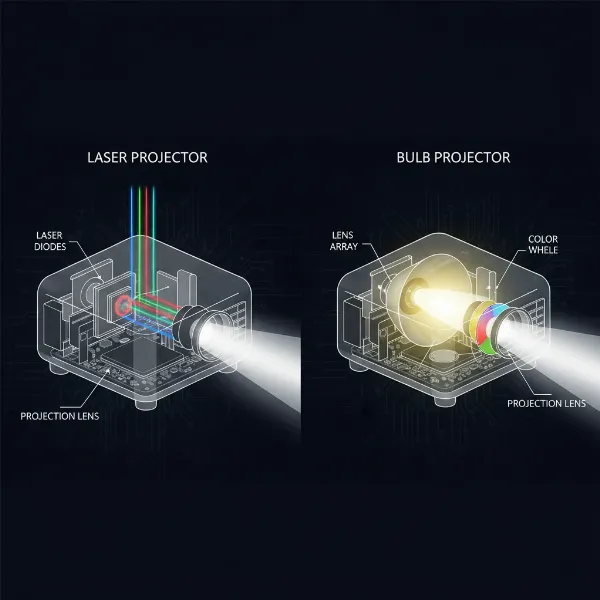 Comparison of laser diode light source and traditional UHP lamp in projectors, highlighting their core differences.
The Lifespan of Bulb Projectors
Bulb projectors have been the workhorse of projection technology for many years, but their light sources come with inherent limitations regarding longevity. Typically, the lamps in these projectors are rated to last anywhere from 1,500 to 5,000 hours of use. Some advanced lamp technologies or projectors operating in a lower brightness “eco mode” might stretch this to 6,000 or even 10,000 hours, but these are often exceptions rather than the rule for standard models.
One of the most significant aspects of bulb projector lifespan is not just when the lamp fails entirely, but how its performance degrades over time. Unlike laser light sources, projector bulbs experience a noticeable and often rapid decline in brightness and color accuracy. It’s common for a lamp to lose up to 50% of its original brightness long before it completely burns out, sometimes after as little as 750 to 2,000 hours. This means that while your bulb might still be functioning, the image quality will become progressively dimmer and duller, impacting your viewing experience.
The cost implications are also considerable. When a bulb reaches the end of its effective life, it must be replaced. Replacement lamps can range from $200 to $500 or more, depending on the projector model. For frequent users, this can translate to recurring expenses every one to two years, significantly increasing the total cost of ownership over the projector’s lifetime. Beyond the financial cost, there’s the inconvenience of downtime during replacement and the environmental impact of disposing of used mercury-containing lamps.
Several factors can accelerate the degradation and shorten the lifespan of a projector bulb:
- Heat Accumulation: Lamps generate a significant amount of heat, and insufficient cooling due to blocked vents or poor ventilation can drastically reduce their life.
- Dust Contamination: Dust can impede cooling and affect optical components, leading to overheating.
- Frequent On/Off Cycles: Each power cycle puts stress on the lamp, shortening its life more quickly than continuous use.
- High Brightness Settings: Running the projector consistently at its highest brightness setting will consume the lamp faster.
- Electrical Instability: Power surges or fluctuations can damage the delicate internal components of the lamp.
The Lifespan of Laser Projectors
Laser projectors stand in stark contrast to their bulb-based counterparts when it comes to longevity. The average lifespan for a modern laser projector is a remarkable 20,000 to 30,000 hours. Some manufacturers even quote figures up to 40,000 hours for certain models. To put this into perspective, if you use a laser projector for four hours a day, it could last for 15 to 20 years before its light source degrades to 50% of its original brightness.
The degradation profile of laser light sources is also fundamentally different. Instead of a sudden or rapid drop in brightness and color, laser projectors exhibit a slow, gradual, and often imperceptible decline over thousands of hours. This means the vibrant, accurate images you enjoy on day one will remain remarkably consistent for many years, without the frustrating dimming experienced with traditional lamps. The concept of “lamp replacement” becomes virtually obsolete, as the laser light engine is designed to last the entire functional life of the projector.
While the initial purchase price of a laser projector is typically higher than a comparable bulb model, the long-term financial benefits are substantial. Eliminating the need for costly lamp replacements dramatically reduces the total cost of ownership. Furthermore, laser projectors are generally more energy-efficient, producing less heat and consuming less power, which can lead to lower electricity bills over their extended lifespan. Maintenance is also simplified, often limited to occasional filter cleaning rather than frequent, delicate lamp swaps.
Despite their robustness, laser projectors are not entirely maintenance-free, and their lifespan can still be influenced by usage patterns:
- Constant Max Brightness: While lasers are durable, continuously operating at 100% brightness might marginally impact their longest potential life.
- Ventilation and Dust: Although they run cooler, proper ventilation and keeping vents clear of dust are still crucial to prevent any internal component stress.
- Power Protection: Like any sophisticated electronic device, protecting a laser projector from power surges with a good surge protector is always a wise practice.
Beyond Just Hours: Key Differences in Longevity and Performance
While the raw “hours” figure is a major differentiator, the choice between laser and bulb extends to several other critical performance and ownership aspects.
Brightness Consistency: This is where laser technology truly shines. Bulb projectors suffer from significant brightness depreciation, meaning the image gets progressively dimmer the longer you use it. Laser projectors, however, maintain a much more stable and consistent light output throughout their rated lifespan. For applications where consistent brightness is crucial—such as large venues, simulation, or even dedicated home theaters—laser projectors deliver an unwavering visual experience.
Maintenance Burden: The absence of lamp replacements in laser projectors translates to vastly reduced maintenance. For schools, businesses, or public installations, this means less downtime, fewer labor costs associated with swapping lamps, and a significant reduction in ongoing operational expenses. Bulb projectors, conversely, necessitate stocking spare lamps and scheduling periodic replacement, which can be disruptive.
Instant On/Off Capabilities: Laser projectors offer immediate power-on and power-off functionality, much like a television. There’s no waiting for the lamp to warm up before you can start projecting, and no prolonged cool-down period after you switch it off. This convenience is a minor but appreciated benefit in fast-paced environments like classrooms or boardrooms. Bulb projectors require a warm-up phase and a cool-down cycle to protect the lamp, adding minutes to each use.
Environmental Impact: With no mercury-filled lamps to dispose of, laser projectors are a more environmentally friendly option. Their lower energy consumption also contributes to a reduced carbon footprint, aligning with growing ecological awareness.
Overall Reliability and Downtime: The solid-state design of laser light sources inherently makes them more reliable and less susceptible to sudden failure compared to the delicate filaments and pressurized gas within a UHP lamp. This enhanced reliability is vital in mission-critical applications where interruptions are unacceptable.
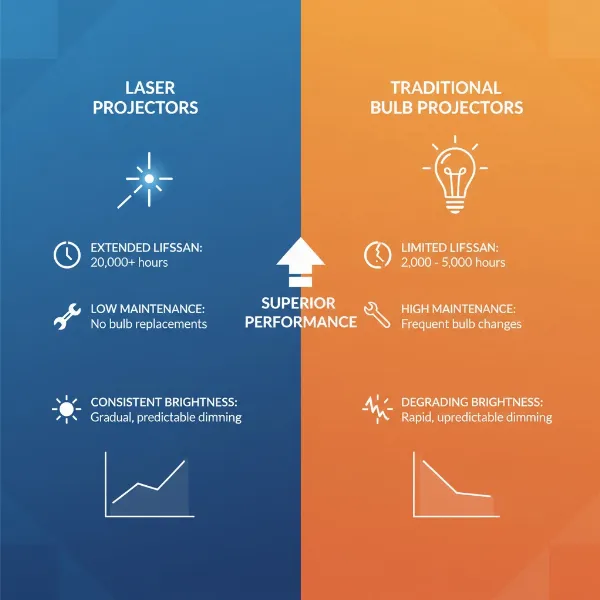 Advantages of laser projectors including longer lifespan and minimal maintenance over bulb types.
Maximizing Your Projector’s Lifespan
Regardless of whether you own a bulb or laser projector, adopting good practices can help maximize its operational life and maintain optimal performance.
For All Projectors:
- Ensure Proper Ventilation: Always place your projector in an area with ample airflow. Do not block the intake or exhaust vents, as overheating is a primary cause of component failure in any electronic device.
- Regular Cleaning: Periodically clean the air filters and vents to prevent dust buildup. Dust acts as an insulator, trapping heat and making the projector work harder.
- Handle with Care: Projectors, especially bulb-based ones, contain delicate components. Avoid sudden jolts or impacts, particularly when the unit is hot.
- Use a Surge Protector: Power fluctuations can damage internal electronics. A quality surge protector is a small investment that can save you from costly repairs.
Specific Tips for Bulb Projectors:
- Utilize Eco Mode: If your viewing environment allows for slightly lower brightness, using the projector’s eco or low lamp mode can significantly extend bulb life.
- Minimize On/Off Cycles: Avoid frequently turning the projector on and off if you plan to use it again within a short period (e.g., 30 minutes). The stress of ignition and cool-down cycles is harder on the bulb than continuous operation.
- Allow Proper Cool-Down: Always let the projector complete its cool-down cycle after use before unplugging or moving it. The internal fan needs time to dissipate heat from the lamp.
Specific Tips for Laser Projectors:
- Follow Manufacturer Guidelines: Adhere to recommended usage patterns and any specific maintenance instructions provided by the manufacturer.
- Consider Brightness Settings: While less critical than with bulbs, running a laser projector slightly below its maximum brightness can potentially eke out even more hours from its already impressive lifespan.
Making the Right Choice: Laser vs. Bulb
When it comes to deciding between a laser and a bulb projector, the lifespan often plays a pivotal role. The “right” choice depends heavily on your individual use case, budget, and priorities.
Choose a Bulb Projector if:
- Initial Cost is Your Priority: Bulb projectors typically have a lower upfront price, making them attractive for those with tighter initial budgets.
- Infrequent or Casual Use: If you only use your projector occasionally for a few hours a week, the shorter bulb lifespan might not be a significant deterrent, as a single lamp could last you several years.
- Value Replaceability: Some users prefer the idea of easily replaceable components, even if it’s a recurring expense.
Choose a Laser Projector if:
- Long-Term Value and Low Maintenance are Key: The significantly longer lifespan and near-zero maintenance make laser projectors more cost-effective over many years, despite a higher initial investment.
- Frequent or Extended Use: For environments like classrooms, businesses, digital signage, or home theaters where the projector will be used for many hours daily, the longevity of a laser projector is an unparalleled advantage.
- Consistent Performance Matters: If stable brightness, accurate color, and reliable operation without degradation are crucial, laser technology is the clear winner.
- Environmental Responsibility: For those prioritizing eco-friendly choices, laser projectors offer reduced waste and lower energy consumption.
The debate often comes down to an initial investment versus the total cost of ownership. While a laser projector may require a larger outlay upfront, the savings on lamp replacements, reduced energy consumption, and minimal maintenance can quickly offset this cost, making it the more economical choice in the long run.
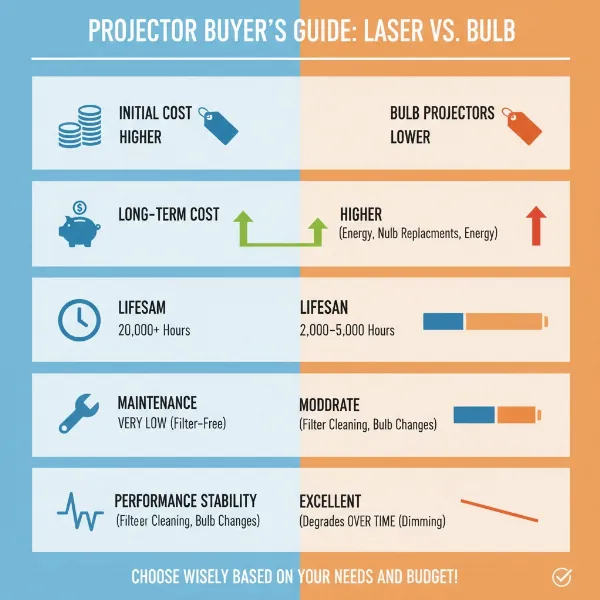 Infographic on choosing between laser and bulb projectors based on lifespan and total cost of ownership.
Conclusion
The lifespan of a projector is far more than just a number; it’s a testament to the underlying technology, influencing everything from image quality to ongoing expenses. While traditional bulb projectors offer an accessible entry point into projection, their limited lifespan and inevitable brightness degradation mean recurring costs and maintenance. Laser projectors, with their exceptional durability and minimal light depreciation, represent the future of projection, offering superior long-term value, consistent performance, and a virtually maintenance-free experience.
As technology continues to evolve, the advantages of laser projectors in terms of longevity and total cost of ownership become increasingly compelling. By considering your usage habits and prioritizing long-term value over initial price, you can choose a projector that not only meets your current visual needs but also continues to deliver brilliant images for many years to come. What factors are most important to you when considering your next projector investment?
Frequently Asked Questions
Do laser projectors ever need maintenance?
|
Our Picks for the Best projector in 2026
As an Amazon Associate I earn from qualifying purchases.
|
||
| Num | Product | Action |
|---|---|---|
| 1 | [Built-in Official Apps/4K Support] Smart Outdoor Projector with WiFi and Bluetooth, 800ANSI Movie Projector, DoIby Audio with Dual Speaker, Auto Focus w/ YouTube&PrimeVideo Proyector, Upgrad P62 Pro |
![Check [Built-in Official Apps/4K Support] Smart Outdoor Projector with WiFi and Bluetooth, 800ANSI Movie Projector, DoIby Audio with Dual Speaker, Auto Focus w/ YouTube&PrimeVideo Proyector, Upgrad P62 Pro on Amazon](https://projectorcam.com/wp-content/plugins/amazon-tables/assets/images/buy.png)
|
| 2 | Epson Pro EX11000 3-Chip 3LCD Full HD 1080p Wireless Laser Projector, 4,600 Lumens Color/White Brightness, Miracast, 2 HDMI Ports, USB Power for Streaming, Built-in 16W Speaker |
|
| 3 | 【Official Licensed Google TV】4K Smart Projector with WiFi and Bluetooth, VOPLLS Outdoor Projectors with Dolby/Auto Focus, Portable Movie Phone Wireless Gaming Wifi Proyector for Bedroom/Home/Celling |
|
| 4 | HAPPRUN Native 1080P Bluetooth Mini Projector, Full HD Portable Outdoor Movie Projector with Built-in Speaker, Compatible with Smartphone, HDMI, USB, AV, Fire Stick, PS5 for Home, Bedroom, Outdoor Use |
|
| 5 | Aurzen Roku TV Smart Projector with Wifi and Bluetooth, Roku Streaming Experience Built-in, 1080P FHD, DoIby Audio, Auto Focus & Keystone, Zoom, Movie Portable Outdoor Mini Projector, White |
|
| 6 | Epson Pro EX9270 Wireless 1080p 3LCD Projector 4,100 Lumens Color and White Brightness, Apple AirPlay, Miracast, Stream from Phone or Laptop, 2 HDMI Ports, 1.6x Optical Zoom, Built-In Speaker |
|
| 7 | [3500 ANSI/ Official Apps/65W Audio] Outdoor 4K Projector with WiFi and Bluetooth, Auto Focus, Auto Keystone Smart Projector Support DoIby Audio, 2026 Upgrade GO2 Short Throw Projector with 360°Stand |
|
| 8 | 【Officially-Licensed APP & Native 1080P】Thinnest 1.81\" Smart Mini Projector with WiFi and Bluetooth, Auto Focus & Keystone Portable Outdoor Projector, VOPLLS 4K Support Home Movie Projector |
|
| 9 | Projector-4K with WiFi and Bluetooth:[3500 ANSI/60W Dolby Audio/Official Licensed Apps], Outdoor-Projector with Smart OS 2.0 & AI Auto Focus,ONOAYO ONO5Pro 2.0 Smart Movie Projector for Indoor/Outdoor |
|
| 10 | 1500 ANSI Official Licensed Google TV Smart Projector, HAPPRUN 4K Full HD Home Theater with Auto Focus, Dolby Sound, Wi-Fi Bluetooth, Built-in Apps, Compatible with Phone & PC, Indoor & Outdoor Use |
|
While laser projectors eliminate the need for lamp replacements, they still benefit from occasional maintenance such as cleaning air filters and ensuring proper ventilation. These simple steps prevent dust buildup and overheating, which can contribute to the overall longevity of the internal components and maintain optimal image quality.
How do I know when to replace a projector bulb?
Most projector lamps show signs of degradation before complete failure, such as noticeable dimming, color shifts, or a flickering image. Many projectors also have a built-in lamp timer or indicator light that will alert you when the lamp is nearing the end of its rated life or has reached a certain number of hours.
Can I extend the life of my projector lamp?
Yes, you can extend the life of a projector lamp by operating it in eco or low power mode, ensuring adequate ventilation to prevent overheating, and minimizing frequent on/off cycles. Allowing the projector to properly cool down after each use also helps preserve lamp longevity.
Is the brightness of a laser projector constant throughout its life?
Laser projectors are designed to maintain a much more stable brightness output over their entire lifespan compared to bulb projectors. While all light sources degrade eventually, the decline in a laser projector is very gradual and often imperceptible for thousands of hours, ensuring consistent image quality for many years.