Picture this: you’ve just unboxed your shiny new projector. The movie starts, and a breathtaking, wall-sized 4K image fills the room. The color is perfect, the brightness is stunning… but the sound is thin, tinny, and coming from the wrong place. It completely shatters the illusion. If you’re wondering How To Get Sound From A Projector that actually matches the epic visuals, you’ve come to the right place. Welcome to Projector Cam, where we live and breathe home cinema.
Getting immersive audio from your projector setup isn’t just a luxury; it’s essential for a true cinematic experience. Many people are surprised to learn that most projectors, even high-end ones, have mediocre-at-best built-in speakers. They’re an afterthought, designed for basic presentations, not for the booming bass of an action movie or the subtle nuances of a film score.
In this guide, we’re going to break down every possible way to liberate your audio, from the simplest plug-and-play solutions to the full-blown home theater setups. Let’s turn that silent picture into a sound-filled spectacle.
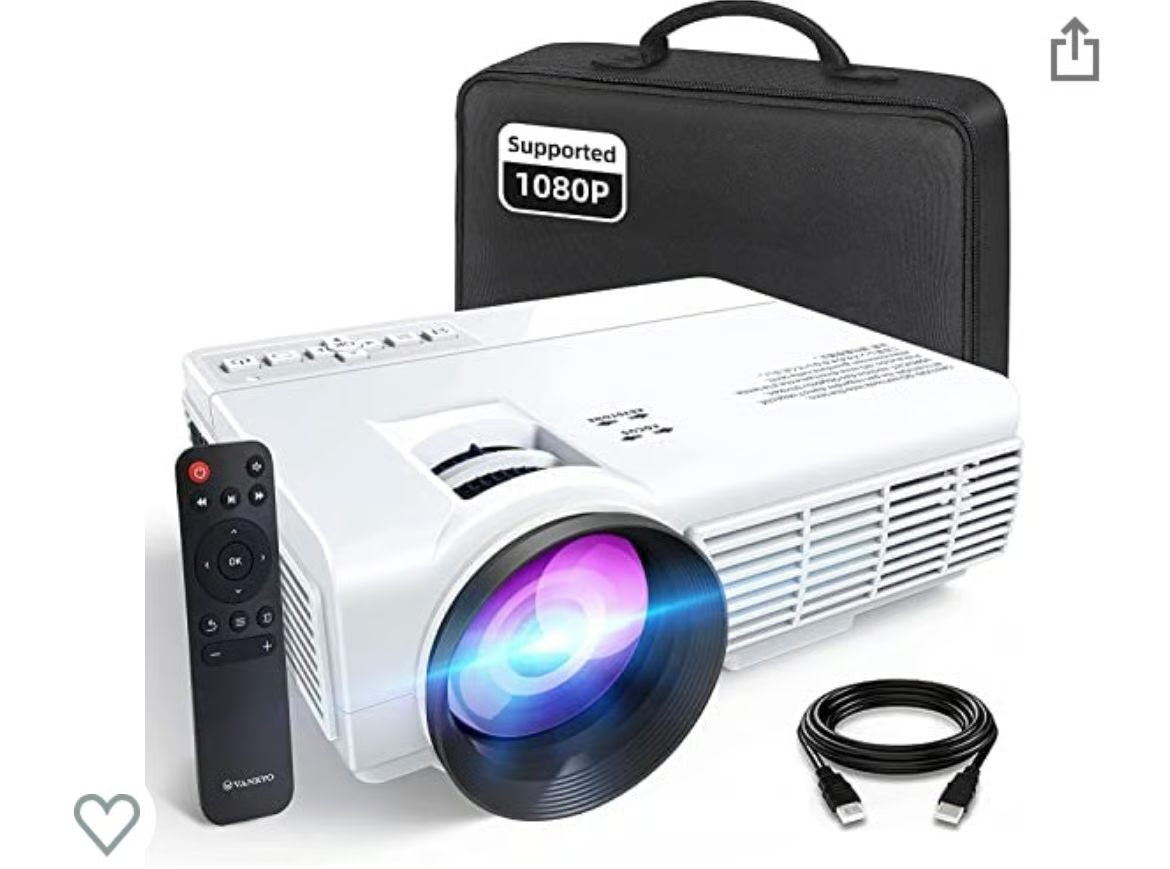
First, Why Are Projector Speakers So Bad?
It’s a fair question. You’ve spent a good chunk of change on a device dedicated to visuals, so why does the audio feel like it’s from a 1990s laptop? The answer comes down to physics and design priorities.
Projectors are all about light and optics. Engineers pour their resources into maximizing lumens (brightness), achieving a high contrast ratio, and perfecting color accuracy. The internal space is packed with lenses, chips (like DLP or LCD panels), and, crucially, powerful lamps and cooling fans.
There’s simply no physical room for large, high-quality speaker drivers and the acoustic chambers they need to produce rich sound. Squeezing in tiny speakers is the only option, and the result is… well, you’ve heard it.
“I always tell my clients the same thing,” says John Carter, a professional Home Theater Installation Expert with over 15 years of experience. “Investing in a projector without a separate audio system is like buying a Ferrari and putting budget tires on it. You’re bottlenecking the entire experience. The audio is half the movie.”
So, let’s ditch those tiny internal speakers and explore the right way to do it.
How to Get Sound From a Projector: Your Connection Options
The method you choose will depend on the ports on your projector, your sound system (be it a soundbar, headphones, or a full AV receiver), and your source device (like a Blu-ray player, streaming stick, or laptop). Here are the most common methods, from simplest to most advanced.
Method 1: The 3.5mm Audio Out (The Old Faithful)
This is the most straightforward analog connection, the same one you’d find on a smartphone or laptop for headphones.
- What it looks like: A standard headphone jack.
- How it works: You run a 3.5mm auxiliary cable from the “Audio Out” port on your projector directly to the “Aux In” port on a soundbar or powered speakers.
- Best for: Simple setups, portable projectors, or connecting to older powered computer speakers. It’s a quick and dirty solution that gets the job done.
- Keep in mind: This is an analog connection. While perfectly fine for many, it won’t support high-fidelity surround sound formats like Dolby Atmos.
Method 2: Bluetooth (The Wireless Wonder)
Many modern projectors come with Bluetooth built-in, offering a clean, wire-free way to connect to your audio gear.
- What it looks like: There’s no cable! It’s a wireless connection.
- How it works: You’ll go into your projector’s settings menu, find the Bluetooth section, and put your Bluetooth soundbar or speakers into pairing mode. Once the projector finds your device, you select it to connect.
- Best for: Minimalist setups where you want to avoid running cables. It’s incredibly convenient for portable projectors or temporary movie nights.
- Keep in mind: Bluetooth can sometimes introduce a slight audio delay, or “latency.” This means you might see an actor’s lips move a fraction of a second before you hear the sound. Many projectors and soundbars have an “audio sync” setting to correct this, but it can be a frustrating issue for cinephiles.
Method 3: Optical Audio / TOSLINK (The Digital Purist)
An optical connection is a big step up in quality from the 3.5mm jack. It sends a digital audio signal over a fiber optic cable.
- What it looks like: A small, squarish port, often with a flap, that glows with a red light when active. The cable connector is called TOSLINK.
- How it works: Connect one end of the optical cable to the “Optical Out” or “Digital Audio Out (Optical)” on your projector and the other end to the corresponding input on your soundbar or AV receiver.
- Best for: Getting high-quality stereo or 5.1 surround sound directly from your projector. It’s a very reliable, interference-free connection.
- Keep in mind: Optical cables can be a bit fragile, so be careful not to bend them too sharply.
Method 4: HDMI ARC/eARC (The All-in-One Hero)
This is the gold standard for modern home theater setups. ARC stands for Audio Return Channel, and it’s a clever feature of the HDMI standard.
- What it looks like: A standard HDMI port, but it will be specifically labeled “HDMI (ARC)” or “HDMI (eARC)”.
- How it works: Normally, an HDMI cable sends video and audio to a display. With ARC, that same cable can also send audio back from the projector to your soundbar or AV receiver. This means you only need one cable for both picture and sound return. eARC (Enhanced Audio Return Channel) is the newer version, supporting higher-bandwidth, uncompressed audio formats like Dolby TrueHD and DTS:X.
- Best for: Anyone with a modern soundbar or AV receiver. It simplifies your wiring and provides the highest possible audio quality.
- Keep in mind: Both your projector and your audio device must have ARC/eARC compatible ports for this to work. You’ll also need to enable a setting called HDMI-CEC on both devices.
Method 5: Connecting to an AV Receiver (The Central Hub)
For the ultimate home theater, an Audio/Video (AV) Receiver is the way to go. Instead of connecting audio from your projector, you connect everything to the receiver first.
- How it works:
- Connect all your source devices (Apple TV, Fire Stick, PlayStation, Blu-ray player) to the HDMI inputs on your AV receiver.
- Connect all your speakers (front, center, rear, subwoofer) to the speaker terminals on the receiver.
- Run a single HDMI cable from the “HDMI Out” port on your receiver to an HDMI input on your projector.
- Why this is the best method: The receiver acts as the traffic cop for all your signals. It strips the high-definition audio from the source and sends it to your speakers, while passing the pristine video signal along to your projector. This guarantees perfect sync and the highest possible audio and video quality.
Projector Sound Not Working? A Quick Checklist
So you’ve connected everything, but you still hear silence? Don’t panic. Before you start pulling all the cables out, run through this simple checklist.
- Check the Projector’s Audio Output Settings: Dive into your projector’s menu. There’s almost always a sound setting where you need to manually select your desired output (e.g., “External Speakers,” “HDMI ARC,” or “Bluetooth”) instead of “Internal Speaker.” This is the most common culprit.
- Verify Your Source Volume: Is the volume on your streaming stick, laptop, or console turned all the way down? It happens to the best of us.
- Confirm the Correct Ports: Are you plugged into an “Audio Out” port on the projector and an “Audio In” port on your speaker system? Double-check that your HDMI cable is in the specific port labeled “ARC” on both devices if you’re using that method.
- Reseat Your Cables: Unplug and firmly plug back in all audio and HDMI cables at both ends. A loose connection can be the simple, frustrating cause.
- Re-pair Bluetooth Devices: If you’re using Bluetooth, try “forgetting” the device on both your projector and speaker, then re-pair them from scratch.
Frequently Asked Questions About Projector Audio
Let’s tackle some of the most common questions we get here at Projector Cam.
Q: Do all projectors have an audio output?
A: Most modern projectors do, but not all. Ultra-portable or budget models might lack audio-out ports entirely, relying on their (usually terrible) built-in speaker. Always check the spec sheet for “Audio Out,” “HDMI ARC,” or “Bluetooth” before you buy.
Q: Can I just connect my soundbar directly to my projector?
A: Yes, absolutely! This is one of the most popular ways how to get sound from a projector. You can use a 3.5mm, Optical, or HDMI ARC cable to connect your soundbar directly to the projector for a massive audio upgrade.
Q: How do I fix the audio delay or lip-sync issue with my Bluetooth speakers?
A: This is called latency. First, check the audio settings on both your projector and your source device for an “AV Sync” or “Audio Delay” setting. This allows you to manually adjust the timing. If that’s not an option, a wired connection (like Optical or 3.5mm) is the most reliable way to eliminate latency.
Q: Is the sound from a projector’s built-in speaker ever good enough?
A: For a casual business presentation in a small room? Maybe. For watching a movie? Almost never. The sound is a critical part of the cinematic experience, and built-in speakers simply can’t deliver the dynamic range and immersion you need.
Q: What is the absolute best way to get sound from a 4K projector?
A: The best method is to use an AV receiver. By connecting your 4K sources to the receiver and then sending only the video to the projector, you ensure you’re getting uncompressed, high-resolution audio formats like Dolby Atmos or DTS:X sent to a proper surround sound system. For a simpler setup, using an eARC-compatible soundbar is a close second.
The Final Takeaway
A stunning, large-screen image deserves sound to match. While it might seem daunting at first, understanding how to get sound from a projector is actually quite straightforward once you know your options.
For a simple and effective upgrade, a soundbar connected via HDMI ARC or Optical is a fantastic choice. For the dedicated enthusiast building a true home cinema, an AV receiver is the non-negotiable heart of your system.
Don’t let poor audio compromise your movie nights. By investing in a separate sound system, you’re not just buying speakers; you’re unlocking the full, immersive potential of your projector. Now, dim the lights, crank up the volume, and enjoy the show as it was meant to be experienced.
Have a question about your specific setup? Share your experience or drop a comment below. We’re always here to help you build the perfect picture.