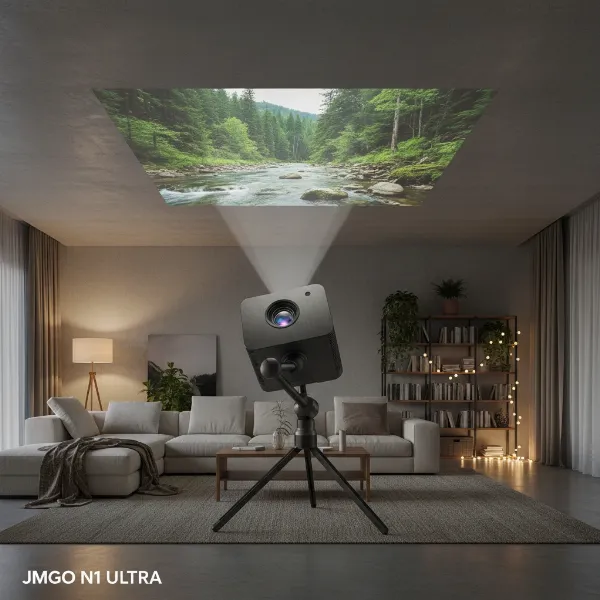
Dreaming of epic movie nights and immersive gaming sessions but living in a cozy apartment? The common misconception is that limited space restricts your ability to create a true cinematic experience at home. However, with the right projector and clever setup strategies, transforming your small apartment into a personal movie theater is not just possible, but surprisingly achievable. This comprehensive guide will walk you through everything you need to know, from choosing the ideal projector to optimizing your space and enhancing the audio, ensuring every viewing is an unforgettable event.
Projector Essentials: Understanding the Heart of Your Home Cinema
A projector is the cornerstone of any home cinema, delivering a grand visual experience far beyond what a traditional television can offer. By casting images onto a screen or a blank wall, projectors immerse you in content, making movies feel more epic and games more engaging. They effectively turn any room into a dynamic entertainment hub.
The evolution of projectors has been remarkable, transitioning from bulky, complex machines primarily found in theaters and boardrooms to sleek, compact, and user-friendly devices perfect for home use. Today’s projectors boast advanced digital technologies that bring incredible clarity and vibrant colors right into your living space. This journey has given rise to several popular types of projectors, each with distinct advantages for different users and environments.
Among the prevalent technologies, you’ll find Digital Light Processing (DLP), Liquid Crystal Display (LCD), Light Emitting Diode (LED), and Laser projectors. DLP projectors are known for their sharp images and excellent contrast, often favored for fast-paced content. LCD projectors typically offer vibrant color saturation and can be a more budget-friendly option. LED projectors stand out for their exceptional lamp life, energy efficiency, and quick startup times, while Laser projectors deliver superior brightness, color accuracy, and an even longer lifespan, albeit at a higher price point. Understanding these types is the first step in crafting your perfect apartment cinema.
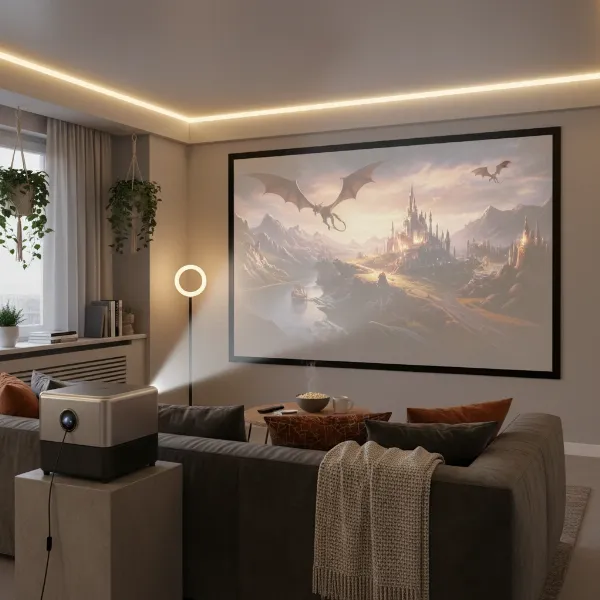 A modern, compact projector casting a vibrant movie scene onto a large screen in a small, stylish apartment living room at night.
Key Factors When Selecting Your Apartment Projector
Choosing the right projector for a small apartment involves more than just picking the first model you see. Several technical specifications directly impact the viewing experience, especially when space is at a premium. Understanding these factors will help you make an informed decision that perfectly matches your apartment’s unique layout and your entertainment desires.
Brightness (Lumens): Measured in lumens, a projector’s brightness is crucial for image visibility, particularly in rooms with ambient light. For a truly dark room, 1,500 lumens might suffice, but for spaces with some ambient light or for daytime viewing, aiming for 2,000 lumens or more is often recommended to maintain a vibrant, clear image.
Resolution: This defines the clarity and detail of the projected image. While SVGA (800×600) and XGA (1024×768) are older standards, 720p (1280×720) offers a decent entry-level experience. For crisp, high-definition visuals, 1080p (1920×1080) is the sweet spot for many, while 4K (3840×2160) provides unparalleled detail, making it ideal for those who want to future-proof their setup.
Contrast Ratio: This indicates the difference between the darkest blacks and the brightest whites a projector can produce. A higher contrast ratio results in images with greater depth, richer colors, and more subtle details, enhancing the overall cinematic feel.
Lamp Life: The lifespan of a projector’s light source varies significantly by technology. Traditional lamp-based projectors might offer 3,000-6,000 hours, while LED and laser projectors can boast impressive lifespans of 20,000 hours or more, translating to years of maintenance-free enjoyment.
Keystone Correction: When a projector cannot be perfectly centered in front of the screen, the image can appear trapezoidal or skewed. Keystone correction, either digital or optical, allows you to adjust the image to be perfectly rectangular. This feature is particularly valuable in small apartments where ideal placement might be challenging due to furniture or room layout. Vertical and horizontal correction offers maximum flexibility.
Throw Ratio: This is arguably the most critical factor for small spaces. The throw ratio determines how far the projector needs to be from the screen to achieve a certain image size. A “short-throw” projector can project a large image from a short distance, while an “ultra-short throw” (UST) projector can sit mere inches from the wall, making it perfect for tiny rooms where traditional projectors simply won’t fit.
Connectivity: Modern projectors offer a variety of connection options. HDMI is standard for high-quality audio and video. VGA is for older computers. USB ports allow direct media playback. Wireless options like Bluetooth, Wi-Fi, and screen mirroring (Chromecast, AirPlay) minimize cable clutter and offer seamless integration with smartphones and other streaming devices, which is a huge benefit in a compact living space.
Comparing Popular Projector Technologies
The world of projectors offers diverse technologies, each with unique strengths and weaknesses. For apartment dwellers, understanding these differences is vital for selecting a device that not only performs well but also fits seamlessly into limited space and lifestyle.
DLP Projectors
|
Our Picks for the Best projector in 2026
As an Amazon Associate I earn from qualifying purchases.
|
||
| Num | Product | Action |
|---|---|---|
| 1 | Mini Smart Projector, 1500 ANSI Portable Projector with WiFi and Bluetooth, HAPPRUN 4K Full HD Home Theater with 270° Stand, Dolby Sound, Built-in Apps,Compatible with Phone & PC, Indoor & Outdoor Use |

|
| 2 | [Built-in Official Apps/4K Support] Smart Outdoor Projector with WiFi and Bluetooth, 800ANSI Movie Projector, DoIby Audio with Dual Speaker, Auto Focus w/ YouTube&PrimeVideo Proyector, Upgrad P62 Pro |
|
| 3 | HAPPRUN Native 1080P Bluetooth Mini Projector, Full HD Portable Outdoor Movie Projector with Built-in Speaker, Compatible with Smartphone, HDMI, USB, AV, Fire Stick, PS5 for Home, Bedroom, Outdoor Use |
|
| 4 | 【Officially-Licensed APP & Native 1080P】Thinnest 1.81\" Smart Mini Projector with WiFi and Bluetooth, Auto Focus & Keystone Portable Outdoor Projector, VOPLLS 4K Support Home Movie Projector |
|
| 5 | Magcubic Mini Projector with WiFi 6 and Bluetooth 5.4, Portable Projector 4K Support, 5W Soundbase Speaker, Auto Vertical Keystone 180°Rotatable Smart Proyector for Movie Home Outdoor |
|
| 6 | Projector-4K with WiFi and Bluetooth:[3000 ANSI/40W Dolby Audio/Official Licensed Apps], Outdoor-Projector with Smart OS 2.0 & AI Auto Focus,ONOAYO ONO5Pro 2.0 Smart Movie Projector for Indoor/Outdoor |
|
| 7 | Mini Projector with Built-in Rechargeable Battery for Outdoor, Portable Projector with WiFi and Bluetooth, 4K Projector for Bedroom, Smart Projector |
|
| 8 | Aurzen Roku TV Smart Projector with Wifi and Bluetooth, Roku Streaming Experience Built-in, 1080P FHD, Dolby Audio, Auto Focus & Keystone, Zoom, Movie Portable Outdoor Mini Projector, White |
|
| 9 | [Officially-Licensed App & Auto Focus]Smart Mini Projector with WiFi and Bluetooth, XuanPad 4K Support Movie Projector, Portable Native 1080P Outdoor Projector with 360° Stand |
|
| 10 | Astronaut Galaxy Projector with Bluetooth Speaker & White Noise, App & Remote Control Star Projector, Galaxy Projector for Bedroom Adults Kids, Spaceman Night Light for Gaming Room, Home Theater |
|
DLP (Digital Light Processing) projectors utilize tiny mirrors on a chip to reflect light, creating a sharp and fluid image. They are renowned for their high contrast ratios and smooth motion handling, making them an excellent choice for action movies and fast-paced gaming where visual clarity is paramount. DLP projectors are often compact and lightweight, fitting well into small apartments. However, some users might experience a “rainbow effect,” a fleeting color artifact, though this is less common in newer models. They are ideal for users prioritizing sharp details and responsive visuals.
LCD Projectors
LCD (Liquid Crystal Display) projectors employ three separate LCD panels, one each for red, green, and blue light, to produce vibrant and saturated colors. These projectors typically offer excellent color accuracy and are often more budget-friendly than their DLP counterparts. They are a great option for home cinema enthusiasts who value rich, true-to-life colors for movies and photography. While generally larger than DLP projectors, many compact LCD models are available.
LED Projectors
LED (Light Emitting Diode) projectors use LEDs as their light source, offering significant advantages, especially for apartment living. They boast an incredibly long lifespan (20,000+ hours), eliminating the need for frequent lamp replacements. LED projectors are also very energy-efficient, generate less heat, and can be remarkably compact. They offer instant on/off functionality and often have good color reproduction. Their portability and longevity make them ideal for flexible setups in small spaces, perfect for casual viewing or moving between rooms.
Laser Projectors
Laser projectors represent the cutting edge of projection technology. They use laser diodes as their light source, delivering exceptional brightness, stunning color accuracy, and incredibly long lifespans (up to 30,000 hours). Laser projectors offer consistent performance over time and can produce incredibly sharp, vibrant images even in rooms with some ambient light. Many ultra-short throw (UST) models use laser technology, allowing them to project massive images from just inches away from the wall. While they are typically the most expensive option, their performance and durability make them a premium choice for dedicated home cinema enthusiasts in apartments.
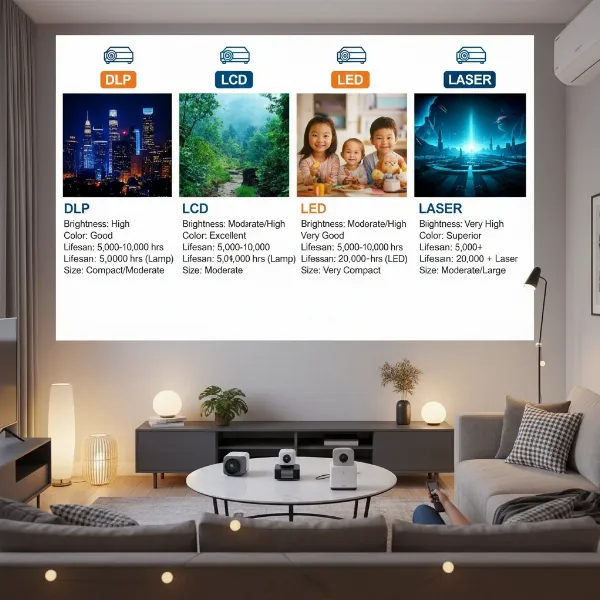 A graphic comparing the visual differences and key features of DLP, LCD, LED, and Laser projectors in a small apartment setting.
Detailed Comparison: DLP vs. LCD vs. LED vs. Laser Projectors
To help you navigate your options, here’s a detailed comparison of the main projector types, highlighting their key specifications and best use cases for a small apartment environment.
| Feature | DLP Projectors | LCD Projectors | LED Projectors | Laser Projectors |
|---|---|---|---|---|
| Image Sharpness | Excellent (razor-sharp) | Very Good (clear, detailed) | Good to Very Good | Outstanding (razor-sharp, high contrast) |
| Color Accuracy | Good (can have “rainbow effect” for some) | Excellent (vibrant, saturated) | Very Good (good color reproduction) | Superior (wide color gamut, precise) |
| Contrast Ratio | High | Good | Good | Excellent |
| Brightness | Moderate to High | Moderate to High | Low to Moderate (but efficient in dark rooms) | Very High (consistent over time) |
| Lamp Life | 3,000 – 6,000 hours (lamp-based) | 3,000 – 6,000 hours (lamp-based) | 20,000 – 30,000+ hours | 20,000 – 30,000+ hours |
| Maintenance | Lamp replacement needed | Lamp replacement, dust filter cleaning | Minimal (no lamp replacement) | Minimal (no lamp replacement) |
| Size/Portability | Often compact, many mini/pico options | Can be larger, but compact models exist | Very compact, highly portable | Varies (some UST are bulky, others compact) |
| Heat & Noise | Moderate | Moderate | Low heat, often quieter | Low to Moderate |
| Price Range | Mid-range | Entry to Mid-range | Entry to Mid-range (good value for longevity) | Premium |
| Best For | Action, gaming, sharp text, smooth motion | Movies, detailed graphics, general home cinema | Flexible setups, casual viewing, frequent travelers | Dedicated home cinema, ultimate quality, UST setups |
Top Projectors for Creating a Cinema Experience in Small Apartments
Finding the perfect projector for your apartment means balancing performance with space-saving design. Here are some top picks across different price segments, ideal for various needs and budgets in a compact environment.
Budget-Friendly Projectors (Under $500)
Affordable projectors can still deliver a surprising cinematic punch for apartment living, focusing on portability and ease of use.
- Anker Nebula Capsule: Shaped like a soda can, this ultra-portable projector is fantastic for spontaneous movie nights. It offers decent resolution (often 720p), a built-in battery for untethered use, and smart TV features, making it incredibly versatile for small spaces. While brightness is modest, it shines in a darkened room. [cite: 5 (portable projectors)]
- ViewSonic M1 Mini / M1+ Mini: These tiny projectors are perfect for extreme portability. They’re incredibly lightweight and can project a respectable image from a very short distance. With integrated stands and decent built-in speakers, they offer a convenient plug-and-play solution for occasional viewing or moving from room to room.
- BenQ GV1 Mini Projector: Another highly portable option, the BenQ GV1 offers a simple, stylish design with good connectivity and a focus on ease of setup. Its auto-keystone correction and Wi-Fi streaming make it an excellent choice for a flexible apartment setup.
Mid-Range Projectors ($500 – $1500)
Stepping up in price unlocks better resolution, brightness, and more advanced features for a truly enhanced apartment cinema.
- XGIMI Halo+: This portable projector delivers 1080p resolution and 700 ISO lumens, making it suitable for clearer images even with some ambient light. With Google TV and a built-in battery offering around 2.5 hours of playtime, it’s a strong contender for apartment dwellers seeking quality and flexibility. [cite: 1 (best projectors)]
- XGIMI MoGo 3 Pro: A compact projector that balances portability with performance, featuring 1080p resolution and Google TV with licensed Netflix. Its coffee-cup size makes it discreet, and it’s well-suited for cozy movie nights or gatherings. [cite: 1 (best projectors), 3 (best portable)]
- Epson EF-12: While needing to be plugged in, the Epson EF-12 offers exceptional contrast and shading, often surpassing other portable projectors. Its Yamaha-tuned sound system is a significant upgrade over typical built-in speakers, providing a more immersive audio experience for your apartment cinema. [cite: 3 (best portable)]
High-End Projectors (Over $1500)
For those seeking the ultimate apartment cinema experience, these projectors deliver stunning 4K visuals and advanced features.
- XGIMI HORIZON Pro / Ultra 4K: These projectors boast 4K resolution, high brightness, and intelligent screen adaptation technology (ISA 3.0), which automatically refines image quality on various surfaces. With Android TV built-in, they offer a comprehensive entertainment solution. The HORIZON Pro, with 1500 ISO Lumens, is particularly noted for its 4K home cinema capabilities. [cite: 1 (best projectors), 2 (best for small rooms)]
- BenQ X500i: Identified as a top short-throw projector, the BenQ X500i is ideal for small spaces where you need a large image from a closer distance. It offers excellent performance for both gaming and movies. [cite: 4 (best projector)]
- LG CineBeam Q: A stylish mini projector that offers very good 4K picture quality with an RGB laser DLP system. Its compact design is perfect for apartment aesthetics, and it runs on the WebOS streaming platform. While its brightness might be limited compared to larger units, it provides a premium, space-conscious solution. [cite: 5 (best portable projectors)]
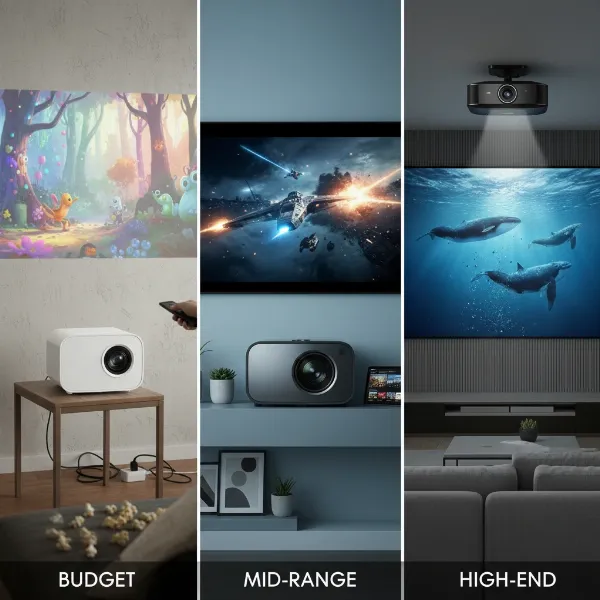 A collage of three different types of projectors (budget, mid-range, high-end) suitable for small apartments, showcasing their compact designs and projecting vibrant movie scenes.
Your Essential Projector Buying Guide for Apartments
Making the right choice for your apartment projector can seem daunting with so many options available. This buying guide simplifies the process, ensuring you select a projector that perfectly fits your space, budget, and viewing habits.
-
Define Your Needs: Begin by considering your primary use. Will you mainly watch movies, play video games, or use it for presentations?
- Movies & TV: Prioritize resolution (1080p or 4K), contrast ratio, and color accuracy for cinematic immersion.
- Gaming: Look for low input lag for responsive gameplay.
- Casual Viewing: Portability, ease of setup (auto-keystone), and smart features might be more important.
-
Set Your Budget: Projectors range widely in price. Establishing a clear budget from the start will help narrow down your options and manage expectations regarding features and performance. Remember to factor in potential accessories like a screen or sound system.
-
Prioritize Key Specifications:
- Throw Ratio: For small apartments, this is paramount. Short-throw or ultra-short-throw (UST) projectors are often your best bet, allowing a large image from a minimal distance. Use a projection calculator (often provided by manufacturers) to determine the ideal throw distance for your room size and desired screen size.
- Brightness: Consider your room’s ambient light. If you can achieve near-darkness with blackout curtains, a lower lumen projector might suffice. For rooms with unavoidable light, opt for higher lumens.
- Resolution: 1080p is a great starting point for clear images, while 4K offers stunning detail if your budget allows.
- Connectivity: Ensure it has the ports you need (HDMI for most devices) and consider wireless options to reduce cable clutter in a small space.
-
Read User Reviews and Expert Opinions: Before making a final decision, delve into reviews from other apartment dwellers or small space users. Their real-world experiences can provide invaluable insights into a projector’s performance, ease of use, and suitability for compact environments.
-
Purchase from a Reputable Retailer: Buying from a trusted store ensures product authenticity, reliable customer service, and a solid warranty, protecting your investment.
Renter-Friendly Installation Tips:
When setting up your projector in an apartment, avoid permanent modifications. Consider:
- Portable Screens or Blank Walls: A blank white wall can serve as a screen, or invest in a portable screen with a tripod or tension-rod mounts. Fixed or electric screens that require drilling are generally not recommended for renters.
- Table Stands or Floor Stands: Instead of ceiling or wall mounts that require drilling, use stable table stands, floor stands, or a strategically placed shelf to position your projector.
- Cable Management: Use Velcro ties or sticky cable clips to organize and conceal cables, keeping your small space tidy and safe. Wireless connectivity options are your best friend here.
Maximizing Your Apartment Cinema: Usage and Maintenance Tips
Once your projector is set up, a few key practices will ensure you get the most out of your cinematic experience and extend the lifespan of your equipment. For apartment living, these tips often involve balancing performance with consideration for your neighbors and the limited space.
Optimize Your Viewing Environment:
- Control Ambient Light: Blackout curtains are your best friend. They block external light, significantly boosting your projector’s contrast and image quality. Smart lighting can also be used to create the perfect movie ambiance, dimming automatically when you start your show.
- Arrange Furniture: Ensure a clear line of sight between your projector and the screen or wall. Rearranging furniture can open up the necessary projection path and optimize viewing angles from your seating.
Enhance Your Audio Experience:
Most projectors have basic built-in speakers, but for a true cinema experience, external audio is a must. [cite: 3 (projector setup)]
- Soundbars or 2.1/3.1 Systems: In a small apartment, a compact soundbar or a 2.1 (two speakers and a subwoofer) or 3.1 (three front speakers and a subwoofer) channel system is often more practical than a full 5.1 or 7.1 surround sound setup. These provide significantly better sound quality without overwhelming your space. [cite: 3 (sound system)]
- Mind Your Neighbors: Bass frequencies travel easily through walls and floors. If you use a subwoofer, be mindful of its volume, especially late at night. Many receivers and sound systems allow you to adjust bass levels. [cite: 4 (sound system)] Consider acoustic treatments like rugs or heavy curtains to help dampen sound within your apartment. [cite: 5 (sound system)]
> “In a smaller apartment, instead of trying to force a 5.1 system into your space, invest your budget in a high-quality 2 or 3 channel system. Better speakers in a simpler setup often outperform a budget 5.1 system.” – Audio Video Unlimited, Home Audio Experts [cite: 3 (sound system)]
Maintenance for Longevity:
- Regular Cleaning: Dust can accumulate on the lens and air filters. Gently clean the lens with a microfiber cloth designed for optics. If your projector has a removable air filter, clean or replace it according to the manufacturer’s instructions to prevent overheating.
- Proper Storage: When not in use for extended periods, store your projector in a cool, dry place, ideally in its original packaging or a protective case, to shield it from dust and accidental damage.
- Troubleshooting Common Issues: If you encounter issues like a blurry image, first check the focus ring and keystone correction. For no signal, confirm all cables are securely connected and you’ve selected the correct input source. Many common problems have simple solutions outlined in your projector’s manual.
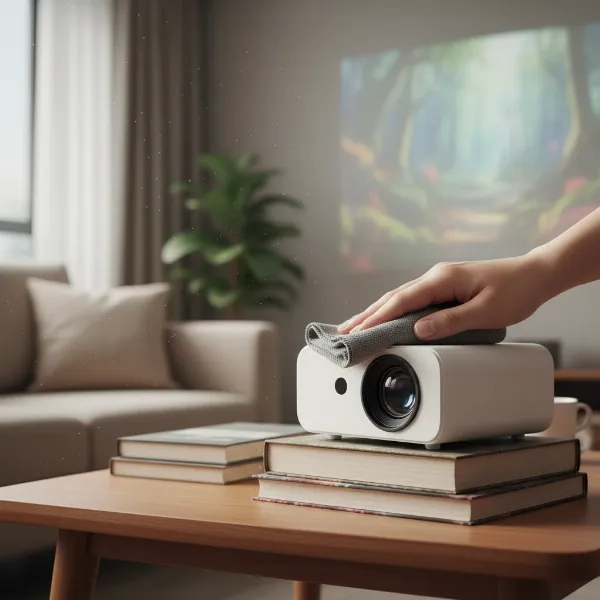 A hand gently cleaning the lens of a compact projector with a microfiber cloth in a small, tidy apartment setting, with a subtle movie scene projected in the background.
Conclusion
Creating a captivating cinema experience in a small apartment is not just a pipe dream; it’s a readily achievable reality with the right approach to technology and space optimization. By carefully selecting a projector with features like short-throw capability, suitable brightness, and essential keystone correction, you can overcome the challenges of limited space. Pairing your projector with a thoughtful audio setup and implementing smart environmental controls, such as blackout curtains, will elevate your viewing sessions from ordinary to extraordinary.
The beauty of modern projector technology lies in its ability to adapt, bringing cinematic magic to even the coziest corners. Whether you’re a film buff, a passionate gamer, or simply enjoy larger-than-life entertainment, your small apartment can indeed become your personal theater. So, what blockbuster will you immerse yourself in first tonight?
Frequently Asked Questions
Can I really get a big screen in a tiny apartment?
Yes, absolutely! Modern short-throw and ultra-short-throw (UST) projectors are specifically designed to project large images, often 100 inches or more, from very short distances – sometimes just inches from the wall. This makes them perfect for apartments where space is limited.
Do I need a special screen, or can I use a wall?
While a dedicated projector screen offers the best image quality, a plain white wall can work well, especially with smart projectors that can adapt to wall color. For optimal results, ensure the wall is smooth, clean, and painted in a matte white or light gray finish. Portable screens are also a great renter-friendly option.
How loud can my home theater sound system be in an apartment without bothering neighbors?
Being considerate is key. While an external sound system greatly enhances the experience, focus on clear audio at moderate volumes rather than excessive bass, which travels easily. Many systems allow you to adjust subwoofer levels independently. Communication with your neighbors can also help prevent issues.
What’s the most important feature for a projector in a small space?
The most crucial feature is the throw ratio, especially short-throw or ultra-short-throw capabilities. This determines how large an image can be projected from a given distance, making it possible to achieve a big screen size even when the projector is placed very close to the wall or screen.
How do I manage cables in a small apartment home cinema setup?
Cable management is vital for aesthetics and safety in compact spaces. Utilize wireless connectivity options like Wi-Fi and Bluetooth whenever possible. For necessary cables, use ties, clips, or cable sleeves to keep them neatly organized and out of sight, preventing clutter.