Have you ever struggled to enjoy a brilliant movie or important presentation because distracting ambient light washed out your projector’s image? In today’s versatile living spaces and conference rooms, achieving truly cinematic visuals often means battling unwanted light from windows, overhead fixtures, or even reflections. This is where Ambient Light Rejecting (ALR) screens step in, transforming your viewing experience by delivering vibrant, high-contrast images even in well-lit environments. If you’re looking to elevate your projection setup, understanding ALR technology is crucial to making an informed choice that perfectly fits your needs.
Understanding Ambient Light Rejecting (ALR) Screens
At its core, an Ambient Light Rejecting (ALR) screen is a specialized projection surface engineered to preserve image quality by minimizing the impact of external light sources. Unlike traditional white projector screens that reflect all light uniformly, ALR screens are designed with precision to block or divert external light while enhancing the projected image. Think of it as a smart filter that knows which light to keep and which to discard, allowing your projector’s output to shine through with clarity and depth.
The magic of ALR technology lies in its advanced multi-layered material construction and optical design. These screens feature microscopic structures and specialized coatings that work together on a principle often referred to as “angular reflectivity” or “selective reflection.” When light from your projector hits the screen, these layers are designed to reflect that light directly back towards the viewer’s field of vision. Simultaneously, ambient light approaching the screen from other angles—be it from overhead lights, windows to the side, or general room illumination—is either absorbed by dark, light-trapping layers or deflected away from the viewer. This sophisticated process prevents unwanted light from scattering across the screen and washing out the image, leading to significantly improved contrast, deeper blacks, and more vivid colors, even when the room isn’t perfectly dark.
Types of ALR Projector Screens
Not all ALR screens are created equal; their design and functionality are often tailored to specific projection setups and ambient light scenarios. Understanding these types is key to selecting the ideal screen for your environment.
Angular Reflective Screens
|
Our Picks for the Best projector in 2026
As an Amazon Associate I earn from qualifying purchases.
|
||
| Num | Product | Action |
|---|---|---|
| 1 | Astronaut Galaxy Projector with Bluetooth Speaker & White Noise, App & Remote Control Star Projector, Galaxy Projector for Bedroom Adults Kids, Spaceman Night Light for Gaming Room, Home Theater |

|
| 2 | Projector-4K with WiFi and Bluetooth:[3000 ANSI/40W Dolby Audio/Official Licensed Apps], Outdoor-Projector with Smart OS 2.0 & AI Auto Focus,ONOAYO ONO5Pro 2.0 Smart Movie Projector for Indoor/Outdoor |
|
| 3 | [Officially-Licensed App & Auto Focus]Smart Mini Projector with WiFi and Bluetooth, XuanPad 4K Support Movie Projector, Portable Native 1080P Outdoor Projector with 360° Stand |
|
| 4 | [Built-in Official Apps/4K Support] Smart Outdoor Projector with WiFi and Bluetooth, 800ANSI Movie Projector, DoIby Audio with Dual Speaker, Auto Focus w/ YouTube&PrimeVideo Proyector, Upgrad P62 Pro |
|
| 5 | Mini Projector with Built-in Rechargeable Battery for Outdoor, Portable Projector with WiFi and Bluetooth, 4K Projector for Bedroom, Smart Projector |
|
| 6 | Magcubic Mini Projector with WiFi 6 and Bluetooth 5.4, Portable Projector 4K Support, 5W Soundbase Speaker, Auto Vertical Keystone 180°Rotatable Smart Proyector for Movie Home Outdoor |
|
| 7 | Mini Smart Projector, 1500 ANSI Portable Projector with WiFi and Bluetooth, HAPPRUN 4K Full HD Home Theater with 270° Stand, Dolby Sound, Built-in Apps,Compatible with Phone & PC, Indoor & Outdoor Use |
|
| 8 | 【Officially-Licensed APP & Native 1080P】Thinnest 1.81\" Smart Mini Projector with WiFi and Bluetooth, Auto Focus & Keystone Portable Outdoor Projector, VOPLLS 4K Support Home Movie Projector |
|
| 9 | Aurzen Roku TV Smart Projector with Wifi and Bluetooth, Roku Streaming Experience Built-in, 1080P FHD, Dolby Audio, Auto Focus & Keystone, Zoom, Movie Portable Outdoor Mini Projector, White |
|
| 10 | HAPPRUN Native 1080P Bluetooth Mini Projector, Full HD Portable Outdoor Movie Projector with Built-in Speaker, Compatible with Smartphone, HDMI, USB, AV, Fire Stick, PS5 for Home, Bedroom, Outdoor Use |
|
Angular reflective ALR screens, sometimes called specular reflective, are engineered to reflect light back at a precise, mirror-opposite angle to the projector’s incidence. This means that if your projector is mounted above the screen and angled downwards, the screen is optimized to reflect that light downwards towards your seating area. They are effective at rejecting ambient light coming from a wide range of directions, particularly from the sides and above. This makes them highly versatile for many home theater and commercial applications, where projectors are typically mounted at standard throw distances.
Fresnel ALR Screens
Specifically designed for Ultra-Short Throw (UST) projectors, Fresnel ALR screens utilize a unique optical structure composed of microscopic, ridged concentric circles. These intricate patterns are engineered to capture the light emitted from a UST projector, which is typically positioned directly below the screen and projects upwards at a steep angle. The Fresnel lens redirects this upward-projected light horizontally towards the viewer while effectively absorbing or diverting ambient light coming from above and the sides. This design ensures a bright and uniform image for viewers positioned directly in front of the screen. However, this focused light reflection can sometimes lead to a narrower optimal viewing angle compared to other ALR types.
Lenticular ALR Screens
Another popular choice for UST projectors are lenticular ALR screens. These screens feature a microscopic sawtooth or ribbed structure with a light-absorbing top layer and a reflective angled layer underneath. This design is highly effective at reflecting light that comes from below the screen (like from a UST projector) directly to the audience, while simultaneously absorbing or deflecting overhead light. Due to their exceptional performance in rejecting light from ceiling fixtures, they are often referred to as Ceiling Light Rejecting (CLR) screens, a specific subset of ALR technology. Lenticular screens deliver excellent contrast and black levels, making them ideal for living rooms where overhead lighting is common.
Form Factors
Beyond the optical technology, ALR screens also come in various physical forms to suit different installation preferences and room aesthetics:
- Fixed-Frame ALR Screens: These screens are permanently stretched over a rigid frame, offering the flattest possible surface for the sharpest images. They are ideal for dedicated home theaters or media rooms where the screen remains a permanent fixture.
- Motorized Drop-Down ALR Screens: Perfect for multi-purpose rooms, these screens can retract into a ceiling or wall-mounted casing when not in use. Many high-quality models feature tab-tensioning mechanisms to ensure a perfectly flat viewing surface when deployed, preventing wrinkles or curling.
- Floor-Rising ALR Screens: Offering a sleek, minimalist solution, these screens rise from a floor-standing console. They are often chosen for luxury setups where a hidden screen is preferred, and wall mounting isn’t an option.
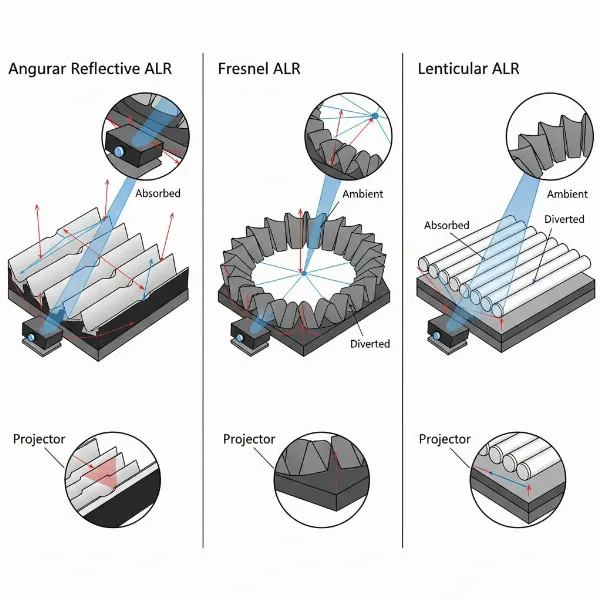 Comparison of different ALR screen types: angular reflective, Fresnel, and lenticular, with light paths illustrated
Key Factors When Choosing an ALR Screen
Selecting the perfect ALR screen involves more than just picking the first option you see. Several critical factors must align with your projector, room environment, and viewing habits to ensure you get the best possible experience.
- Ambient Light Conditions: This is paramount. Assess the amount of natural and artificial light in your room. Is the light coming mostly from overhead, from windows on the sides, or is it indirect? Different ALR screen types excel at rejecting light from specific directions. For instance, CLR (Ceiling Light Rejecting) screens are optimized for overhead light, while other ALR types handle side light more effectively.
- Projector Type and Throw Ratio: The type of projector you own or plan to purchase heavily influences your screen choice.
- Ultra-Short Throw (UST) Projectors: These projectors sit very close to the screen and project upwards. They require specialized UST ALR screens, such as Fresnel or lenticular designs, which are specifically engineered to reflect light coming from a steep, upward angle. Using a standard ALR screen with a UST projector will result in a dim or inconsistent image.
- Standard/Long Throw Projectors: These projectors are typically mounted further back from the screen. Most angular reflective ALR screens are suitable for these setups.
- Screen Gain: Gain measures how much light a screen reflects. A gain of 1.0 reflects light equally in all directions, similar to a white wall. ALR screens often have gains ranging from 0.6 to 1.5. Lower gain values (e.g., 0.6-0.8) enhance contrast and black levels by absorbing more light, making them suitable for bright projectors. Higher gain values (e.g., 1.0-1.5) make the image brighter, which can be beneficial for lower lumen projectors, but can sometimes introduce “hot-spotting” (a visibly brighter area on the screen) or sacrifice some contrast.
- Viewing Angle: ALR screens achieve their light-rejecting properties by concentrating reflected light towards the primary viewing axis. This can sometimes result in a narrower optimal viewing angle compared to traditional matte white screens. If you have a wide seating arrangement, ensure the ALR screen you choose offers a sufficiently broad viewing cone to prevent off-axis viewers from experiencing a dimmer image.
- Size and Aspect Ratio: Choose a screen size appropriate for your room dimensions and viewing distance to ensure comfortable viewing. The aspect ratio (e.g., 16:9 for most modern content, 2.35:1 for cinematic widescreen) should match your primary content and projector’s native resolution.
- Budget and Installation: ALR screens are generally more expensive than traditional screens due to their complex manufacturing process. Consider your budget and whether you prefer a fixed installation or a motorized, retractable option for multi-purpose spaces.
ALR Screens vs. Traditional White Projector Screens
The fundamental difference between ALR screens and traditional matte white screens lies in their approach to light management. Understanding these distinctions is crucial for determining which screen is best suited for your specific viewing environment.
Traditional Matte White Screens:
These screens have a diffuse surface that reflects light evenly in all directions.
-
Benefits:
- Neutral Color Reproduction: They offer the most accurate color representation when ambient light is completely controlled.
- Wide Viewing Angle: Light is scattered broadly, providing a consistent image across a very wide viewing cone.
- Cost-Effective: Generally more affordable than ALR screens.
- Ideal for Dark Rooms: Perform exceptionally well in dedicated home theaters where total light control is possible.
-
Limitations:
- Highly Susceptible to Ambient Light: Any stray light source will quickly wash out the image, reducing contrast and vibrancy. Blacks appear gray, and colors become dull.
- Low Contrast in Bright Environments: They simply cannot compete with ambient light, making them unsuitable for rooms with uncontrolled lighting.
Ambient Light Rejecting (ALR) Screens:
These screens use advanced optical technology to selectively reflect projector light and absorb/deflect ambient light.
-
Benefits:
- Superior Contrast in Lit Rooms: They maintain impressive contrast and deep black levels even with significant ambient light. This means you can enjoy your projector in a living room with the lights on or during the day.
- Vibrant Colors: By minimizing light interference, ALR screens allow projected colors to appear richer and more saturated.
- Versatility: Ideal for multi-purpose rooms, media spaces, and conference rooms where controlling ambient light isn’t always feasible or desired.
-
Limitations:
- Higher Cost: The sophisticated materials and engineering make ALR screens considerably more expensive.
- Potential for Narrower Viewing Angles: While many modern ALR screens offer wide viewing angles, some specialized types (like certain Fresnel screens) can have a more limited sweet spot compared to matte white screens.
- Not Always Superior in Perfect Darkness: In a perfectly dark, light-controlled room, a high-quality matte white screen can sometimes deliver a slightly brighter or more uniform image for all viewers. ALR screens, by their nature of absorbing some light, might slightly reduce overall brightness in absolute darkness.
- Projector Matching: Optimal performance often requires careful matching with projector type and throw ratio, especially for UST setups.
When to Choose Each:
- Choose a Traditional Matte White Screen if: You have a dedicated, light-controlled home theater where you can achieve near-total darkness, and budget is a primary concern.
- Choose an ALR Screen if: You plan to use your projector in a living room, media room, conference room, or any space where ambient light is present and cannot be fully eliminated. If you have an Ultra-Short Throw projector, an ALR screen (specifically UST ALR, Fresnel, or Lenticular) is almost a necessity for a good viewing experience.
> “The true value of an ALR screen isn’t just about making your image brighter; it’s about preserving the dynamic range and color fidelity of your projected content, even when your environment isn’t perfectly dark. It bridges the gap between traditional projection and the convenience of a large-screen TV.” – John Smith, Lead AV Engineer, Projectorcam.com
Tips for Optimizing Your ALR Screen Experience
Even with the best ALR screen, a few strategic considerations can further enhance your viewing pleasure and ensure you’re getting the most out of your investment.
- Proper Projector Placement: This is paramount, especially for UST ALR screens. For UST projectors, ensure the projector is placed at the exact recommended distance and height from the screen to align with the screen’s optical properties. For long-throw projectors with angular reflective ALR screens, make sure the projector is mounted at an angle that directs light efficiently to your primary viewing positions. Misalignment can lead to uneven brightness or compromised light rejection.
- Supplemental Room Light Control: While ALR screens work wonders in ambient light, complete darkness will always yield the absolute best contrast and black levels. Consider adding dimmable lights, blackout curtains, or blinds to areas with excessive light if you want to push your ALR screen’s performance to its limits for critical viewing.
- Regular Maintenance: ALR screens, particularly optical ones, can be delicate. Use a soft, lint-free microfiber cloth and a gentle, non-abrasive cleaner (often provided by the manufacturer) to dust and clean the screen. Avoid harsh chemicals or excessive pressure, as this can damage the specialized optical layers. Always consult the manufacturer’s cleaning instructions.
- Calibrate Your Projector: To truly maximize the visual impact, consider professionally calibrating your projector with your ALR screen. This ensures accurate colors, optimal contrast, and the best possible picture performance tailored to your specific screen and room.
Conclusion
Ambient Light Rejecting (ALR) screens have revolutionized the way we experience projected images, liberating projectors from the confines of dedicated dark rooms. By intelligently managing ambient light, these screens enable projectors to deliver stunningly vibrant, high-contrast visuals in virtually any environment, from bustling living rooms to dynamic conference spaces. Whether you’re building a new home theater or upgrading an existing setup, understanding the various types of ALR technology, their working principles, and the key factors for selection empowers you to make a choice that perfectly aligns with your projector, room conditions, and viewing preferences.
Ready to see your favorite content come alive with unparalleled clarity, even in a brightly lit room? Choosing the right ALR screen is the first step towards a truly immersive and versatile viewing experience. What factors are most important for your ideal projector setup?
Frequently Asked Questions
Are ALR screens worth the investment?
Yes, ALR screens are generally worth the investment if you plan to use your projector in a room with ambient light. They significantly improve image contrast, color saturation, and overall picture quality compared to traditional white screens in such environments, making projector viewing enjoyable beyond dark, dedicated home theaters.
Can you use a regular projector with an ALR screen?
Yes, most ALR screens are compatible with regular (long-throw) projectors. However, if you have an Ultra-Short Throw (UST) projector, you must use a specialized UST ALR screen (like Fresnel or lenticular designs) for optimal performance, as standard ALR screens are not designed for the steep projection angle of UST models.
What is the difference between ALR and CLR screens?
CLR (Ceiling Light Rejecting) screens are a specific type of ALR screen primarily designed to reject ambient light coming from overhead light sources. While all CLR screens are ALR screens, not all ALR screens are optimized specifically for ceiling light. CLR screens are especially popular for UST projectors and rooms where overhead lighting is the main concern.
Do ALR screens make the image darker?
ALR screens achieve their effect by absorbing or diverting unwanted ambient light, and sometimes this process can slightly reduce the overall brightness of the projected image compared to a high-gain matte white screen in a perfectly dark room. However, this slight reduction is usually offset by a dramatic improvement in contrast and black levels in a room with ambient light, resulting in a much more vivid and watchable picture.
How do I clean an ALR screen without damaging it?
To clean an ALR screen, use a soft, lint-free microfiber cloth to gently dust the surface. For deeper cleaning, lightly dampen the cloth with distilled water or a cleaning solution specifically recommended by the screen manufacturer. Avoid using harsh chemicals, abrasive materials, or excessive pressure, as these can damage the screen’s delicate optical layers and coatings.