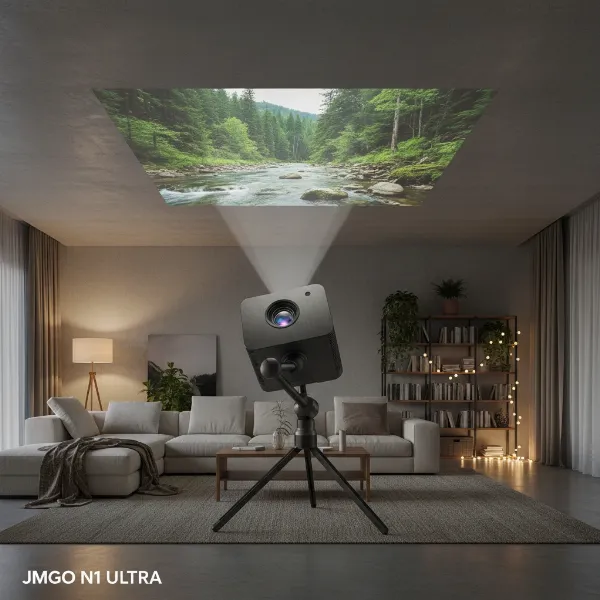
The Ascent of 8K Projectors: Are We Truly There Yet?
The pursuit of ultimate cinematic immersion at home has long driven innovation in display technology. In this relentless quest for visual perfection, 8K projectors have emerged as the cutting edge, promising an unparalleled level of detail and realism that could redefine the home theater experience. However, a crucial question remains: Is this groundbreaking technology mature enough for widespread adoption, or is it still a luxury reserved for a select few early adopters? This article will delve into the current state of 8K projection, explore the underlying technology, outline the key factors to consider when making a purchase, and highlight some of the top models currently available.
The Evolution of Projection Technology: A Brief Overview
At its core, a projector is a device that projects an image or video onto a surface, typically a projection screen, making it indispensable for large-scale viewing in both professional and home settings. Historically, projection technology has evolved from simple magic lanterns to complex digital systems. Early projectors relied on film, while modern iterations harness various light and display technologies.
Major types of projectors include Digital Light Processing (DLP), Liquid Crystal Display (LCD), Light Emitting Diode (LED), and Laser. While DLP and LCD have been mainstays for decades, LED and especially Laser light sources are gaining prominence due to their longevity and performance benefits. The transition from 4K to 8K resolution marks a significant leap, though it’s important to note that for consumer 8K projectors, pixel-shifting remains the dominant and most accessible method of achieving an apparent 8K image.
Unpacking 8K Projector Technology: Native vs. Pixel-Shift
True 8K resolution boasts an impressive 7680×4320 pixels, totaling over 33 megapixels – four times the pixel count of 4K. This massive increase in detail promises images with incredible clarity and depth.
Native 8K projectors achieve this resolution using a display chip with 33 million individual pixels. These devices are characterized by extremely high pixel density, delivering uncompromised 8K fidelity. However, due to their intricate engineering and manufacturing complexity, native 8K projectors, such as those from Digital Projection, are exceptionally expensive and primarily targeted at professional and commercial applications, making them largely out of reach for the typical home user.
In contrast, 8K Pixel-Shift Technology, often branded as “e-shiftX” by manufacturers like JVC, offers a more consumer-friendly approach. This method utilizes a 4K display panel and rapidly shifts the pixels diagonally by half a pixel both horizontally and vertically. By displaying two slightly offset 4K images in quick succession, the projector creates the perception of an 8K image by effectively doubling the displayed pixels on screen. This process happens so fast that the human eye perceives a single, higher-resolution image rather than two distinct 4K frames. While this approach is a subject of debate regarding its “true” 8K status, many users find the visual difference compelling and often indistinguishable from native 8K at typical viewing distances.
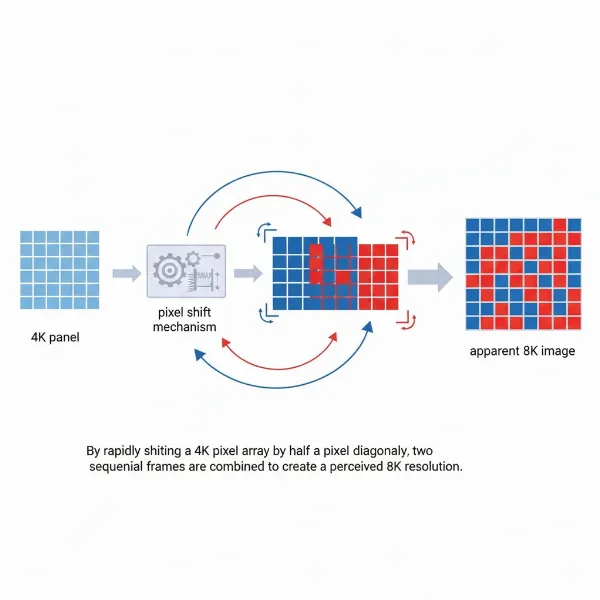 An illustrative diagram demonstrating 8K pixel-shift technology, showing how two shifted 4K frames create an apparent 8K image.
Crucial Considerations When Choosing an 8K Projector
Selecting the right 8K projector involves a careful evaluation of several technical specifications and features to ensure it meets your specific home theater needs and environment.
Resolution: The fundamental distinction between native 8K and pixel-shift 8K is paramount. While native offers uncompromising detail, pixel-shift provides an excellent balance of performance and accessibility for most home users.
Brightness (Lumens): The projector’s light output is critical for image visibility, especially in rooms with ambient light. For dedicated, light-controlled home theaters, a projector with 2,000+ lumens is often sufficient. However, for brighter rooms or larger screen sizes, 3,000+ lumens are recommended to maintain image vibrancy and detail.
Contrast Ratio: This spec defines the difference between the darkest blacks and the brightest whites. Both native and dynamic contrast ratios contribute to image depth and the realism of black levels. Higher contrast ratios result in more impactful and engaging visuals.
Light Source (Lamp Life): Modern 8K projectors increasingly feature laser light sources. Lasers offer significant advantages over traditional lamps, including an impressive lifespan of 20,000+ hours, consistent brightness output over time, and quicker startup/shutdown times.
Connectivity: To fully leverage 8K content and high-refresh-rate gaming, ensure the projector includes HDMI 2.1 ports, which support 8K/60p and 4K/120p signals. Other useful ports might include USB for media playback and LAN for network control.
Throw Ratio: This determines the distance a projector needs to be from the screen to achieve a certain image size. Short-throw options are available for those with limited space, allowing large images from a close distance.
HDR Support: High Dynamic Range (HDR) significantly expands the contrast and color capabilities of an image. Look for support for standards like HDR10, HLG, and HDR10+. Advanced implementations like HDR10+ and JVC’s Frame Adapt HDR further optimize dynamic range on a scene-by-scene basis.
Color Gamut: A wider color gamut translates to more accurate and vibrant colors. Key color spaces to consider include REC.709 for standard HD, DCI-P3 for cinematic content, and BT.2020 for the widest range of colors available in modern HDR content.
Gaming Features: For avid gamers, features such as low latency modes and support for high refresh rates (e.g., 4K/120p) are essential for a smooth and responsive gaming experience on a massive screen.
Size and Weight: High-end 8K projectors can be quite substantial in size and weight, often requiring careful planning for installation, whether ceiling-mounted or placed on a dedicated stand.
Price: This is a major determining factor, as 8K projectors currently reside in a premium segment, with significantly higher price points compared to their 4K counterparts.
A Head-to-Head: 8K Projector Technology Comparison
DLP Projectors
DLP (Digital Light Processing) projectors utilize an array of microscopic mirrors that tilt rapidly to create an image. They are known for their sharp images and good contrast. While some high-end DLP models offer excellent performance, they are less common for dedicated 8K home theater applications and typically rely on pixel-shifting to achieve 8K resolution. A potential drawback for some sensitive viewers can be the “rainbow effect,” though this is less common in higher-end single-chip DLP projectors.
LCD Projectors
LCD (Liquid Crystal Display) projectors typically employ three separate LCD panels (one for red, green, and blue) to generate the image. They are lauded for their excellent color reproduction. However, they often exhibit lower native contrast ratios compared to DLP or LCoS (Liquid Crystal on Silicon) technologies. Some 8K pixel-shift projectors do utilize LCD panels as their core imaging technology.
LED Projectors
LED projectors use an LED light source instead of a traditional lamp or laser. Their primary advantages include a very long lifespan, instant on/off capabilities, and often a compact form factor. However, historically, high-lumen LED projectors have been less common, especially for 8K applications, limiting their use in very bright environments. The technology is emerging, but high-brightness 8K LED projectors are still rare.
Laser Projectors (Focus for 8K)
Laser projectors utilize a laser light source, often combined with DLP or LCoS imaging chips. This combination is particularly well-suited for 8K projection. The why Laser is Key for 8K lies in its ability to deliver exceptional brightness, consistent color over thousands of hours, a wide color gamut (often covering the BT.2020 standard), and a remarkably long lifespan of 20,000+ hours. These attributes are crucial for maximizing the impact of 8K resolution and HDR content. While the initial cost of laser projectors is higher, their operational longevity and superior performance often justify the investment.
Top 8K Projectors Redefining Home Cinema (Focus on JVC)
When it comes to high-performance 8K projectors for the home, JVC has consistently been at the forefront, particularly with its D-ILA (Direct-Drive Image Light Amplifier) technology combined with laser light sources and advanced pixel-shifting.
Premium 8K Projectors (Above $9,000)
JVC DLA-NZ9: Often considered a flagship model, the DLA-NZ9 offers an unparalleled home cinema experience. It features JVC’s proprietary 8K e-shiftX technology, delivering a stunning 8K image. With a brightness of 3,000 lumens, a native contrast ratio of 100,000:1 (and an astonishing Infinity:1 dynamic contrast), full BT.2020 color gamut support, and Frame Adapt HDR, it produces incredibly detailed, vibrant, and deep images. It fully supports 8K/60p and 4K/120p inputs, all powered by a durable 20,000-hour laser light source, solidifying its position as a top-tier choice for enthusiasts.
JVC DLA-NZ8: A slightly more accessible sibling to the NZ9, the DLA-NZ8 still offers exceptional performance. It shares many of the NZ9’s advanced features but with a slightly lower brightness of 2,500 lumens and a native contrast ratio of 80,000:1. Despite these minor differences, it remains an incredibly capable and highly regarded 8K projector.
JVC DLA-NZ7: As the entry-level model in JVC’s laser-driven 8K e-shift series, the DLA-NZ7 provides an excellent pathway into true 8K home cinema. It delivers 2,200 lumens of brightness, a 40,000:1 native contrast ratio, and Infinity:1 dynamic contrast. While it primarily covers the REC.709 color space, it still supports 8K/60p and 4K/120p, benefiting from the same 20,000-hour laser life as its more expensive counterparts.
JVC DLA-NX9 / RS3000: This model represents an older generation of JVC’s 8K e-shift technology, utilizing a traditional lamp-based light source rather than a laser. Despite being lamp-based with a lamp life of 4,500 hours, it still delivered high performance for its time, offering 2,200 lumens and a 100,000:1 native contrast ratio. It remains a highly capable projector for those seeking a value option in the pre-laser 8K market.
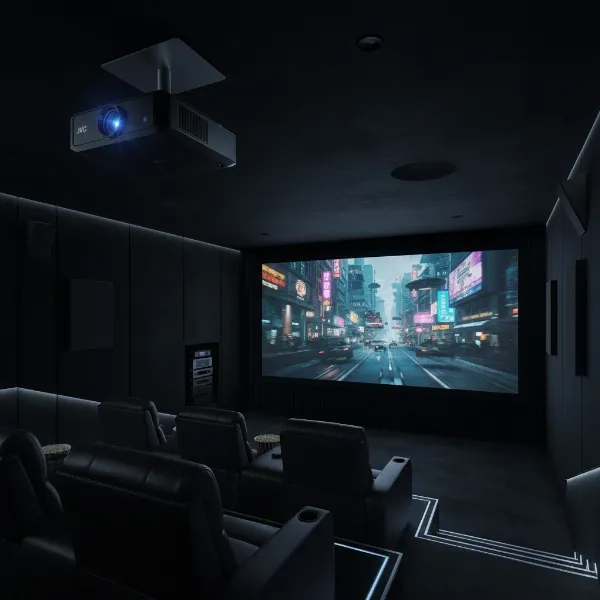 A premium JVC D-ILA NZ9 8K laser projector displaying a vibrant cinematic scene in a dark home theater.
The Question of “Budget” 8K
It’s important to acknowledge that truly “budget” 8K projectors, in the sense of being readily affordable for the average consumer, are not yet available. The technology’s complexity and the high-end components involved keep prices elevated. For those with a more constrained budget seeking a high-quality large-screen experience, advanced 4K projectors remain excellent alternatives. For instance, models like the Epson LS12000 (a 4K PRO-UHD laser projector) offer superb image quality and value, even if they don’t achieve a full 8K pixel-shifted resolution.
The Ultimate 8K Projector Buying Guide
To navigate the premium 8K projector market effectively, consider these essential steps:
- Define Your Needs: Determine your primary use case. Are you seeking ultimate cinematic quality for movies, low latency and high refresh rates for gaming, or a versatile mixed-use projector?
- Set a Realistic Budget: Understand that 8K projectors occupy a premium segment. Be prepared for a significant investment, especially for laser-based models.
- Understand the Technology: Grasping the distinction between native 8K and pixel-shift 8K is critical to setting appropriate expectations and making an informed decision.
- Prioritize Key Specs: Focus on the specifications most important to your viewing environment and preferences, such as brightness for your room’s ambient light, contrast for image depth, and a laser light source for longevity and consistent performance.
- Check Connectivity: Ensure the projector offers the necessary HDMI 2.1 ports for compatibility with your 8K sources and gaming consoles.
- Read Reviews & Seek Expert Advice: Don’t rely solely on manufacturer specifications. Consult professional reviews and seek advice from home theater experts for real-world performance insights.
- Consider Installation: Account for the projector’s size, weight, and throw distance during your planning. Features like lens shift and keystone correction can aid in installation flexibility.
Maximizing Your 8K Projector Experience: Tips and Maintenance
Once you’ve invested in an 8K projector, optimizing your viewing environment and performing regular maintenance will ensure you get the most out of your high-end system.
- Optimal Viewing Environment: A dedicated dark room provides the best conditions for maximizing contrast, color accuracy, and overall image impact from your 8K projector.
- Screen Selection: Pair your 8K projector with a high-quality, perfectly flat projection screen. ALR (Ambient Light Rejecting) screens can further enhance black levels and contrast in rooms with some ambient light.
- Regular Cleaning: Periodically clean dust filters and the projector lens according to the manufacturer’s instructions to maintain optimal image clarity and prevent overheating.
- Firmware Updates: Keep your projector’s software up to date. Manufacturers frequently release firmware updates that can improve performance, add new features, or fix bugs.
- Calibration: For the absolute best image quality, consider a professional calibration. A calibrator can fine-tune color accuracy, white balance, and gamma settings to your specific projector and screen combination.
Conclusion
The era of 8K projection is undeniably here, offering a visual feast for home cinema enthusiasts. While native 8K remains a niche for professional applications, the advancements in pixel-shift laser models, particularly from brands like JVC, provide an unparalleled home entertainment experience. These projectors deliver breathtaking detail, vibrant colors, and deep contrast, truly pushing the boundaries of immersive viewing.
So, are we there yet? For those seeking the pinnacle of visual fidelity, willing to invest in cutting-edge technology, the answer is a resounding yes. The current generation of 8K pixel-shift projectors is highly capable and transforms home entertainment into a genuinely cinematic event. Explore these advanced projectors to transform your home entertainment and step into the future of display technology.
What aspect of 8K projection excites you most?
Frequently Asked Questions
Is native 8K resolution truly necessary for home theater?
While native 8K offers the highest pixel density, current 8K pixel-shift projectors deliver stunning results that are often indistinguishable from native 8K at typical viewing distances, making them an excellent choice for most home users.
How much content is available in 8K?
Native 8K content is still scarce, but 8K projectors excel at upscaling 4K and even 1080p content, making existing libraries look better. Many modern projectors also support advanced HDR formats.
Do 8K projectors require special screens?
To fully appreciate the detail of an 8K projector, a high-quality, perfectly flat screen is recommended. ALR (Ambient Light Rejecting) screens can further enhance contrast in rooms with some ambient light.
Can 8K projectors be used for professional gaming?
Yes, premium 8K pixel-shift projectors like the JVC NZ series support 4K/120p input and feature low latency modes, offering an incredibly immersive and responsive gaming experience on a large scale.
Semantic Keywords: home theater projector, cinema immersion, pixel-shifting, D-ILA, laser light source, high contrast, HDR, HDMI 2.1, gaming projector, projection technology, display resolution.