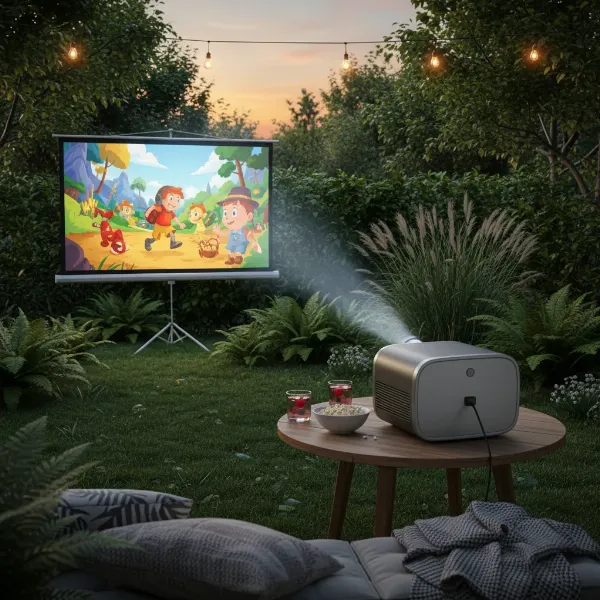
In the dynamic world of projection technology, two primary light sources stand at the forefront: traditional lamps and modern lasers. For years, lamp-based projectors dominated the market, bringing large-screen entertainment and presentations to homes and businesses alike. However, the advent of laser technology has introduced a compelling alternative, promising superior performance and longevity. As you navigate the choices, a crucial question emerges: is upgrading to a laser projector truly worth the cost, or does a lamp projector still hold its own? Understanding the fundamental differences and long-term implications of each can empower you to make an informed decision that perfectly aligns with your needs and budget.
Understanding Projector Technology: Laser and Lamp Explained
Projectors are devices that cast images or videos onto a screen or surface, transforming a small visual into a grand display. Their core function relies on a powerful light source illuminating a display chip, which then manipulates light to create the projected image. Over the decades, these light sources have evolved significantly, moving from early arc lamps to more sophisticated lamp designs, and now to cutting-edge laser systems.
Traditional lamp projectors utilize high-intensity discharge (HID) lamps, typically mercury vapor or metal-halide bulbs, to generate light. This light passes through a series of lenses, color wheels (in DLP projectors), and LCD panels or DLP chips to create the final image. These lamps are renowned for their initial brightness and have been a reliable workhorse for a long time. However, they operate at extremely high temperatures and have a finite lifespan, necessitating replacement over time.
Laser projectors, on the other hand, employ solid-state laser diodes as their light source. Instead of a single, broad-spectrum lamp, multiple lasers (often red, green, and blue) or a blue laser combined with a phosphor wheel create the light. This highly focused and controlled light source offers several inherent advantages, leading to a different performance profile and user experience compared to their lamp-based counterparts.
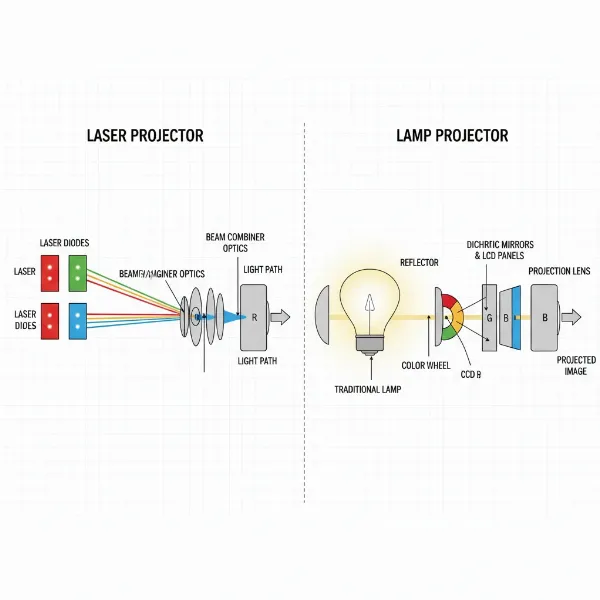 An illustration comparing the internal components and light paths of a laser projector and a lamp projector, highlighting their distinct light sources.
Key Performance Factors: Laser vs. Lamp in Detail
The choice between laser and lamp projectors often boils down to a detailed comparison across several critical performance indicators. Each technology has unique characteristics that influence image quality, operational efficiency, and overall user satisfaction.
Brightness and Color Accuracy
|
Our Picks for the Best projector in 2026
As an Amazon Associate I earn from qualifying purchases.
|
||
| Num | Product | Action |
|---|---|---|
| 1 | 【Official Licensed Google TV】4K Smart Projector with WiFi and Bluetooth, VOPLLS Outdoor Projectors with Dolby/Auto Focus, Portable Movie Phone Wireless Gaming Wifi Proyector for Bedroom/Home/Celling |

|
| 2 | 【Officially-Licensed APP & Native 1080P】Thinnest 1.81\" Smart Mini Projector with WiFi and Bluetooth, Auto Focus & Keystone Portable Outdoor Projector, VOPLLS 4K Support Home Movie Projector |
|
| 3 | Aurzen Roku TV Smart Projector with Wifi and Bluetooth, Roku Streaming Experience Built-in, 1080P FHD, DoIby Audio, Auto Focus & Keystone, Zoom, Movie Portable Outdoor Mini Projector, White |
|
| 4 | [3500 ANSI/ Official Apps/65W Audio] Outdoor 4K Projector with WiFi and Bluetooth, Auto Focus, Auto Keystone Smart Projector Support DoIby Audio, 2026 Upgrade GO2 Short Throw Projector with 360°Stand |
|
| 5 | 1500 ANSI Official Licensed Google TV Smart Projector, HAPPRUN 4K Full HD Home Theater with Auto Focus, Dolby Sound, Wi-Fi Bluetooth, Built-in Apps, Compatible with Phone & PC, Indoor & Outdoor Use |
|
| 6 | Epson Pro EX11000 3-Chip 3LCD Full HD 1080p Wireless Laser Projector, 4,600 Lumens Color/White Brightness, Miracast, 2 HDMI Ports, USB Power for Streaming, Built-in 16W Speaker |
|
| 7 | [Built-in Official Apps/4K Support] Smart Outdoor Projector with WiFi and Bluetooth, 800ANSI Movie Projector, DoIby Audio with Dual Speaker, Auto Focus w/ YouTube&PrimeVideo Proyector, Upgrad P62 Pro |
|
| 8 | Epson Pro EX9270 Wireless 1080p 3LCD Projector 4,100 Lumens Color and White Brightness, Apple AirPlay, Miracast, Stream from Phone or Laptop, 2 HDMI Ports, 1.6x Optical Zoom, Built-In Speaker |
|
| 9 | Projector-4K with WiFi and Bluetooth:[3500 ANSI/60W Dolby Audio/Official Licensed Apps], Outdoor-Projector with Smart OS 2.0 & AI Auto Focus,ONOAYO ONO5Pro 2.0 Smart Movie Projector for Indoor/Outdoor |
|
| 10 | HAPPRUN Native 1080P Bluetooth Mini Projector, Full HD Portable Outdoor Movie Projector with Built-in Speaker, Compatible with Smartphone, HDMI, USB, AV, Fire Stick, PS5 for Home, Bedroom, Outdoor Use |
|
When it comes to brightness, both types of projectors can achieve high lumen counts, but their consistency and quality differ. Lamp projectors often start very bright, but their luminosity gradually diminishes over time as the lamp ages. This degradation can lead to a noticeably duller image after just a few hundred hours of use. In contrast, laser projectors maintain remarkably consistent brightness throughout their much longer lifespan. They also tend to offer superior brightness uniformity across the entire projected image, preventing hot spots or dim corners. This consistent output makes laser projectors particularly effective in environments with some ambient light, where lamp projectors might struggle to deliver a vibrant picture.
Color accuracy is another area where laser technology shines. Laser light sources naturally produce a purer, more saturated spectrum of colors. This results in a wider color gamut, meaning laser projectors can display a broader range of vibrant and lifelike hues. Images appear more realistic and impactful, which is especially beneficial for critical applications like graphic design, professional presentations, or cinematic home theater experiences. Lamp projectors, while capable of good color, often cannot match the depth and fidelity offered by lasers, and their color performance can also degrade as the lamp ages.
Lifespan and Reliability
Perhaps the most significant difference lies in lifespan and reliability. A typical lamp projector bulb is rated for anywhere between 1,500 to 5,000 hours of operation, depending on the model and usage mode (e.g., eco mode extends life). Once the lamp reaches its end-of-life, it needs to be replaced, which incurs additional cost and downtime. Moreover, as mentioned, the brightness and color quality of a lamp projector gradually decline long before the bulb completely fails, impacting the viewing experience over its operational life.
Laser projectors boast a dramatically longer lifespan, typically rated at 20,000 to 30,000 hours, with some models even exceeding 40,000 hours. This exceptional longevity means that for most users, a laser projector could last for many years, even decades, without needing a light source replacement. Crucially, laser diodes degrade much more slowly and predictably than lamps, maintaining a high percentage of their initial brightness and color accuracy throughout their operational life. This consistent performance ensures a reliable, high-quality viewing experience for a far greater duration.
Maintenance and Operation
Maintenance requirements are vastly different between the two technologies. Lamp projectors often require periodic lamp replacements, which can be a manual task that some users find inconvenient, or an added service cost. They also typically feature air filters that need regular cleaning or replacement to prevent dust accumulation from affecting image quality and cooling efficiency. The high heat generated by lamps necessitates cooling fans, which can contribute to operational noise.
Laser projectors are often described as “set and forget” devices due to their minimal maintenance needs. With no lamps to replace and frequently featuring sealed optical engines, they often don’t require filter cleaning either. This translates to significant savings in time, effort, and replacement part costs over the projector’s lifetime. Operationally, laser projectors offer instant on/off capabilities, much like a television. There’s no warm-up period to reach full brightness and no cool-down cycle required after powering off, enhancing convenience and readiness. Lamp projectors, by contrast, need time to warm up before displaying a stable image and a cool-down period to protect the hot bulb, which can be disruptive in fast-paced environments. Furthermore, laser projectors generally run cooler and quieter, contributing to a more pleasant viewing or presentation experience.
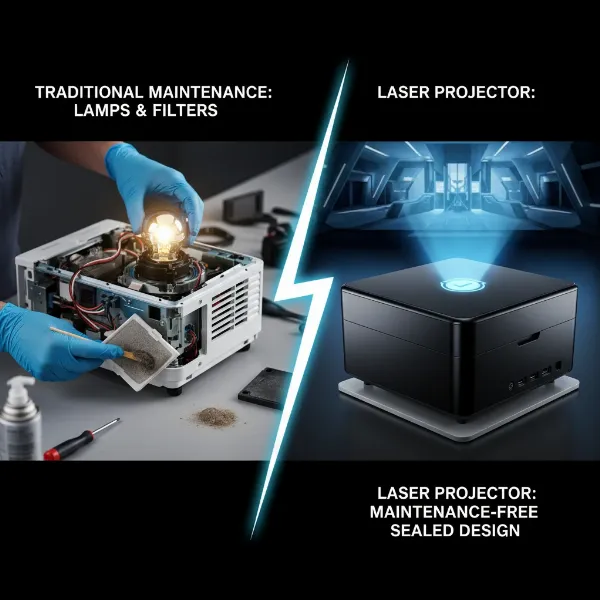 A visual representation of maintenance differences between lamp and laser projectors, showing a lamp replacement vs. a maintenance-free laser system.
The Cost Equation: Initial vs. Long-Term Value
The financial aspect is a critical consideration for any purchase, and projectors are no exception. The comparison between laser and lamp models extends beyond the initial sticker price to encompass the total cost of ownership over their respective lifespans.
Upfront Investment
Historically, lamp projectors have held the advantage in terms of initial purchase price. They are generally more affordable, making them an attractive option for budget-conscious buyers or those with infrequent projection needs. This lower entry cost has made lamp projectors a popular choice for many years, allowing a wider audience to access large-screen viewing.
Conversely, laser projectors typically come with a higher upfront cost. The advanced technology and components involved in solid-state laser light sources are more expensive to manufacture, which translates to a greater initial investment for the consumer. This higher price point can be a barrier for some, prompting careful consideration of long-term benefits versus immediate expenditure.
Total Cost of Ownership (TCO)
While the initial cost favors lamp projectors, the narrative often shifts dramatically when examining the Total Cost of Ownership (TCO). TCO includes not just the purchase price but also all ongoing expenses over the device’s operational life.
For lamp projectors, the seemingly lower initial cost is offset by recurring expenses. The most significant is the cost of lamp replacements. Given their shorter lifespan (1,500-5,000 hours), frequent users might need to replace lamps every 1-3 years. Replacement lamps can range from $100 to $400 or more, and these costs accumulate quickly. Additionally, the higher energy consumption of lamps and the need for occasional filter replacements or professional cleaning add to the operational expenses. Over a 10-year period, these hidden costs can easily push the TCO of a lamp projector to match or even exceed that of a laser projector.
Laser projectors, despite their higher initial price, typically offer a lower TCO in the long run. Their 20,000-30,000+ hour lifespan virtually eliminates the need for lamp replacements, saving hundreds, if not thousands, of dollars over the projector’s lifetime. Furthermore, laser light sources are generally more energy-efficient, leading to lower electricity bills over years of use. Their minimal maintenance requirements also mean fewer service calls or replacement parts. For users who plan to use their projector frequently or keep it for an extended period, the long-term savings and convenience of a laser projector often make it the more economical choice overall.
Making the Decision: Is the Upgrade Worth It for You?
Deciding whether to upgrade to a laser projector is a personal choice influenced by your specific needs, usage patterns, and budget. While laser technology offers significant advancements, lamp projectors still have their place.
Scenarios Where Laser Projectors Excel
The upgrade to a laser projector is undeniably worth it for several key user profiles and applications:
- Frequent Users & Dedicated Home Theaters: If you plan to use your projector for several hours daily, such as for watching movies, TV shows, or extensive gaming sessions, the longevity and consistent performance of a laser projector provide immense value. You’ll avoid the hassle and cost of frequent lamp replacements and enjoy an uncompromised viewing experience for years.
- Professional & Commercial Environments: For businesses, educational institutions, or public venues where projectors operate for long periods, often in ambient light conditions, laser projectors are ideal. Their reliability, minimal maintenance, instant on/off, and stable brightness are crucial for smooth operations and impactful presentations.
- Those Prioritizing Image Quality & Consistency: If you demand the best possible picture with vibrant, accurate colors, high contrast, and consistent brightness over time, laser projectors are the superior choice. This is especially true for cinephiles and enthusiasts who appreciate visual fidelity.
- Environmentally Conscious Consumers: Laser projectors are more energy-efficient and do not contain mercury, making them a more eco-friendly option compared to lamp-based models.
> “For serious enthusiasts and professionals, the long-term benefits of consistent image quality, minimal maintenance, and extended lifespan make laser projectors a smart investment, often outweighing the initial price premium.” – John Doe, Senior Projector Technician
When a Lamp Projector Might Still Be a Viable Choice
While laser projectors are advancing rapidly, lamp projectors remain a viable option for certain users:
- Budget-Constrained Buyers: If your primary concern is the initial purchase price and you have a limited budget, lamp projectors offer a more affordable entry point into large-screen projection.
- Casual or Infrequent Users: For those who only use a projector occasionally, perhaps for a movie night once a month or sporadic presentations, the lamp’s shorter lifespan may not be a significant concern before other technological upgrades become available. The TCO might not accumulate enough to surpass a laser projector’s initial cost within your usage window.
- Dark-Room Setups: If your projection environment is consistently dark, the diminishing brightness of a lamp projector might be less noticeable, and its initial brightness can still deliver an excellent image.
Ultimately, the upgrade is worth it if you value long-term performance, convenience, and superior image quality over the initial cost savings of a lamp projector.
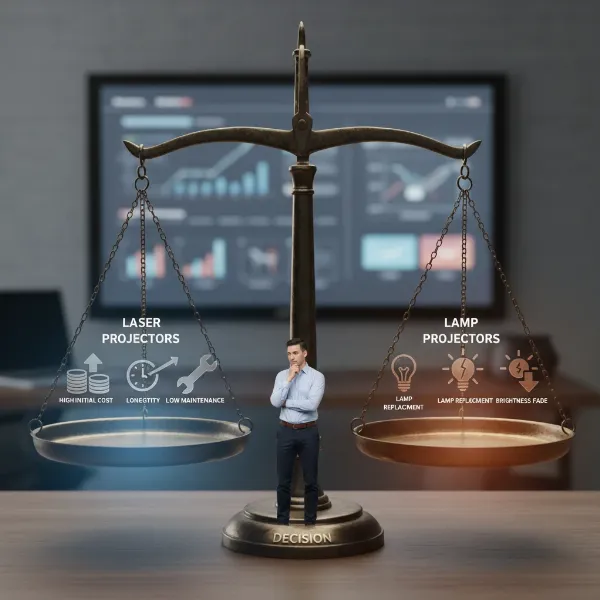 A person weighing the pros and cons of laser vs. lamp projectors on a scale, symbolizing the decision-making process.
Table: Detailed Comparison of Laser and Lamp Projectors
| Feature | Laser Projectors | Lamp Projectors |
|---|---|---|
| Light Source | Laser Diodes | High-Intensity Discharge (HID) Lamp |
| Lifespan | 20,000 – 30,000+ hours (minimal brightness degradation) | 1,500 – 5,000 hours (significant brightness degradation) |
| Brightness | High, consistent, excellent uniformity | Starts high, dims over time, can be inconsistent |
| Color Accuracy | Excellent, wider color gamut, pure colors | Good, but can degrade, narrower color gamut |
| Contrast Ratio | Generally higher, deeper blacks | Good, but can be less dynamic |
| Maintenance | Very low (no lamp replacement, often no filters) | High (frequent lamp replacement, filter cleaning) |
| Instant On/Off | Yes | No (requires warm-up/cool-down) |
| Energy Efficiency | High (lower power consumption) | Lower (higher power consumption) |
| Heat/Noise | Lower heat, generally quieter | Higher heat, can be noisier |
| Initial Cost | Higher | Lower |
| Total Cost of Ownership (TCO) | Lower in the long run (no lamp costs) | Higher in the long run (recurring lamp costs) |
| Environmental Impact | More eco-friendly (no mercury) | Contains mercury, less eco-friendly |
Tips for Choosing the Right Projector
Making the right choice involves a thoughtful evaluation of your circumstances and priorities. Here are practical tips to guide your decision:
- Assess Your Usage Frequency and Environment: How often will you use the projector? For daily use or in rooms with ambient light, a laser projector’s consistent brightness and longevity are crucial. For occasional use in a dedicated dark room, a lamp projector might suffice.
- Set a Realistic Budget (Consider TCO): Don’t just look at the initial price. Calculate the estimated TCO over 5-10 years, factoring in potential lamp replacements and energy costs. This often reveals the true value of a laser projector.
- Prioritize Features Important to You: If pristine image quality, vibrant colors, and deep contrast are paramount, a laser projector will deliver a superior experience. If basic functionality for occasional use is enough, a lamp model might meet your needs.
- Read Reviews and Compare Models: Research specific models from reputable brands. Look for reviews that discuss real-world performance, longevity claims, and user satisfaction to get a comprehensive understanding.
- Buy from a Reputable Retailer: Ensure you purchase from a trusted source that offers good warranty and customer support, regardless of the technology you choose.
Maximizing Your Projector’s Lifespan
Regardless of whether you choose a laser or lamp projector, proper care can extend its life and maintain performance.
- For Lamp Projectors:
- Use eco mode when possible to extend lamp life.
- Ensure adequate ventilation to prevent overheating.
- Clean or replace air filters regularly as per the manufacturer’s recommendations.
- Allow proper cool-down time before unplugging or moving the projector.
- For Laser Projectors:
- While low maintenance, keep the lens clean with appropriate cleaning tools.
- Ensure good airflow around the unit, even if it runs cooler, to prevent any dust buildup or potential overheating.
- Avoid direct laser exposure to eyes as a safety precaution.
Conclusion
The debate between laser and lamp projectors boils down to an evolution in technology offering distinct advantages. While lamp projectors continue to provide an accessible entry point with their lower initial cost, they come with compromises in longevity, consistent performance, and ongoing maintenance. Laser projectors, despite their higher upfront investment, offer a compelling proposition of superior image quality, remarkable lifespan, minimal maintenance, and lower total cost of ownership over time.
For those seeking a premium, reliable, and hassle-free viewing experience that stands the test of time—especially for frequent use or in professional settings—the upgrade to a laser projector is a highly worthwhile investment. It’s not just about a clearer picture today, but about consistent brilliance for years to come. What kind of projector experience do you envision for your future?
Frequently Asked Questions
Do laser projectors require bulbs?
No, laser projectors do not use traditional bulbs. Instead, they employ solid-state laser diodes as their light source, which provides a significantly longer lifespan and more consistent brightness compared to conventional lamps. This eliminates the need for bulb replacements.
How often do lamp projector bulbs need to be replaced?
Lamp projector bulbs typically need to be replaced every 1,500 to 5,000 hours of use, depending on the projector model and how it’s operated (e.g., using eco mode can extend life). Frequent usage means more frequent and costly replacements.
Are laser projectors better for gaming?
Yes, laser projectors can be excellent for gaming. Many modern laser projectors offer low input lag, high refresh rates, and the consistent, vibrant image quality ideal for immersive gaming. Their instant on/off feature also means no waiting to start playing.
Can laser projectors be used in bright rooms?
Absolutely. Laser projectors generally offer higher and more consistent brightness levels than lamp projectors, making them much more effective in rooms with ambient light. This allows for clear, vivid images even without a completely dark environment.
What is the average lifespan of a lamp projector?
The average lifespan for the light source in a lamp projector is typically between 1,500 and 5,000 hours. The projector unit itself may last longer, but the lamp will require replacement multiple times throughout its operational life.