Imagine transforming your backyard into a magical open-air cinema, a perfect setting for family movie nights, romantic dates, or fun gatherings with friends. The dream of a stunning outdoor theater often comes with a hefty price tag, but it doesn’t have to. With a smart approach to sourcing equipment and embracing creative DIY solutions, you can create an unforgettable cinematic experience right in your own backyard without breaking the bank. This comprehensive guide will walk you through every step, helping you choose the right components and set up your budget-friendly outdoor movie oasis, ensuring you make informed choices that fit your needs and wallet.
Understanding Projectors: The Heart of Your Outdoor Cinema
At the core of any great movie night, whether indoors or out, is the projector. A projector is an optical device that projects an image or moving images onto a surface, commonly a projection screen. Historically, projectors have evolved from magic lanterns to complex digital systems, becoming increasingly accessible for home use. For an outdoor setup, understanding the various types and their suitability for different environments is crucial, especially when working with a budget.
When considering projector types, the most common technologies are Digital Light Processing (DLP), Liquid Crystal Display (LCD), and more modern LED and Laser projectors. Each has its own set of advantages and disadvantages concerning image quality, maintenance, and, most importantly, cost. For budget-conscious DIY enthusiasts, DLP and LCD projectors often present the most cost-effective entry points, while LED projectors offer compelling long-term savings on lamp replacements. Laser projectors, while offering superior performance, generally fall outside the typical budget-friendly scope.
Key Factors When Choosing a Budget Projector
Selecting the right projector for your outdoor theater involves balancing performance with your budget. Understanding the critical specifications will help you make an informed decision without overspending on features you don’t need in a casual outdoor setting.
Brightness (Lumens): This is arguably the most crucial factor for outdoor projectors. Measured in lumens, brightness determines how well the image stands up to ambient light. For a truly dark backyard (after sunset), a projector with 2,000 to 2,500 lumens might suffice. However, if you plan to start before complete darkness or have some ambient light, aiming for 3,000 lumens or more will provide a much clearer and more vibrant picture. Look for projectors that offer a good lumen-to-price ratio within your budget.
Resolution: Resolution defines the sharpness and detail of your projected image. Common resolutions include SVGA (800×600), XGA (1024×768), 720p (1280×720), 1080p (1920×1080), and 4K (3840×2160). For a budget backyard theater, 720p or 1080p are the sweet spots. They offer a significant upgrade over lower resolutions without the premium price tag of 4K, which is often overkill for casual outdoor viewing distances.
Contrast Ratio: This specification indicates the difference between the darkest blacks and the brightest whites a projector can display. A higher contrast ratio results in more detailed images with greater depth. While important, it can sometimes be a compromise for budget projectors. Look for the highest contrast ratio you can afford, but prioritize brightness and resolution first for outdoor use.
Lamp Life: The projector’s light source has a finite lifespan. Traditional lamp-based projectors are often cheaper upfront but require bulb replacements, which can be costly. LED and laser projectors, though sometimes pricier initially, boast significantly longer lamp lives (20,000+ hours), saving you money and hassle in the long run. When budgeting, consider the total cost of ownership, including potential lamp replacements.
Keystone Correction: This feature allows you to correct image distortion when the projector isn’t perfectly perpendicular to the screen. Manual keystone correction is common on budget models and is highly useful for quick and flexible outdoor setups, ensuring your picture is always a perfect rectangle.
Throw Ratio: The throw ratio describes the distance a projector needs to be from the screen to produce a certain image size. It’s calculated by dividing the throw distance by the image width. Understanding this helps you plan your backyard layout to ensure your projector can create the desired screen size from your available space.
Connectivity: Modern projectors typically offer various input options. HDMI is essential for connecting most streaming devices, laptops, and Blu-ray players. USB ports can be useful for playing media directly from a flash drive, while VGA is still present on some older or budget models. Wireless connectivity (Wi-Fi or Bluetooth) can simplify setup by reducing cable clutter, but wired connections are often more reliable outdoors.
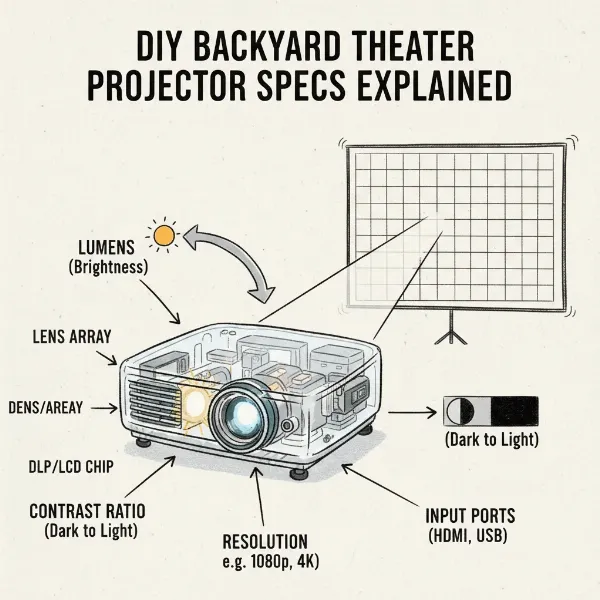 A diagram showing key factors for choosing a projector like lumens, resolution, and contrast ratio for a backyard theater.
Comparing Popular Projector Types for Budget Setups
When building your outdoor cinema on a budget, a clear understanding of projector technologies will guide your decision. Each type offers a unique balance of cost, performance, and longevity.
DLP Projectors
DLP (Digital Light Processing) projectors use tiny mirrors on a chip to reflect light, creating the image.
- Pros: Often known for producing sharp images and good contrast for their price point. They are generally compact and portable, making them suitable for temporary outdoor setups. Many budget-friendly models utilize DLP technology.
- Cons: Some users might experience a “rainbow effect” with certain DLP projectors, where brief flashes of color are visible, especially for those sensitive to it.
- Best for: Budget-conscious users prioritizing sharp image clarity and portability for occasional outdoor use.
|
Our Picks for the Best projector in 2026
As an Amazon Associate I earn from qualifying purchases.
|
||
| Num | Product | Action |
|---|---|---|
| 1 | 1500 ANSI Official Licensed Google TV Smart Projector, HAPPRUN 4K Full HD Home Theater with Auto Focus, Dolby Sound, Wi-Fi Bluetooth, Built-in Apps, Compatible with Phone & PC, Indoor & Outdoor Use |

|
| 2 | [3500 ANSI/ Official Apps/65W Audio] Outdoor 4K Projector with WiFi and Bluetooth, Auto Focus, Auto Keystone Smart Projector Support DoIby Audio, 2026 Upgrade GO2 Short Throw Projector with 360°Stand |
|
| 3 | 【Officially-Licensed APP & Native 1080P】Thinnest 1.81\" Smart Mini Projector with WiFi and Bluetooth, Auto Focus & Keystone Portable Outdoor Projector, VOPLLS 4K Support Home Movie Projector |
|
| 4 | [Built-in Official Apps/4K Support] Smart Outdoor Projector with WiFi and Bluetooth, 800ANSI Movie Projector, DoIby Audio with Dual Speaker, Auto Focus w/ YouTube&PrimeVideo Proyector, Upgrad P62 Pro |
|
| 5 | Projector-4K with WiFi and Bluetooth:[3500 ANSI/60W Dolby Audio/Official Licensed Apps], Outdoor-Projector with Smart OS 2.0 & AI Auto Focus,ONOAYO ONO5Pro 2.0 Smart Movie Projector for Indoor/Outdoor |
|
| 6 | Epson Pro EX9270 Wireless 1080p 3LCD Projector 4,100 Lumens Color and White Brightness, Apple AirPlay, Miracast, Stream from Phone or Laptop, 2 HDMI Ports, 1.6x Optical Zoom, Built-In Speaker |
|
| 7 | 【Official Licensed Google TV】4K Smart Projector with WiFi and Bluetooth, VOPLLS Outdoor Projectors with Dolby/Auto Focus, Portable Movie Phone Wireless Gaming Wifi Proyector for Bedroom/Home/Celling |
|
| 8 | Aurzen Roku TV Smart Projector with Wifi and Bluetooth, Roku Streaming Experience Built-in, 1080P FHD, DoIby Audio, Auto Focus & Keystone, Zoom, Movie Portable Outdoor Mini Projector, White |
|
| 9 | HAPPRUN Native 1080P Bluetooth Mini Projector, Full HD Portable Outdoor Movie Projector with Built-in Speaker, Compatible with Smartphone, HDMI, USB, AV, Fire Stick, PS5 for Home, Bedroom, Outdoor Use |
|
| 10 | Epson Pro EX11000 3-Chip 3LCD Full HD 1080p Wireless Laser Projector, 4,600 Lumens Color/White Brightness, Miracast, 2 HDMI Ports, USB Power for Streaming, Built-in 16W Speaker |
|
LCD Projectors
LCD (Liquid Crystal Display) projectors pass light through three separate LCD panels (red, green, and blue) before combining them to form a full-color image.
- Pros: Typically offer excellent color accuracy and often have a lower cost for higher resolutions compared to older DLP models. They generally produce images without the “rainbow effect” sometimes associated with DLP.
- Cons: Can sometimes have visible pixels at closer viewing distances (the “screen door effect”) and might have slightly lower contrast than equivalent DLP models.
- Best for: Those who prioritize vibrant and accurate colors and want a good balance of features at an affordable price.
LED Projectors
LED (Light Emitting Diode) projectors use LED light sources instead of traditional lamps. They can be based on DLP or LCD technology for image processing.
- Pros: Their biggest advantage for a budget is extremely long lamp life (20,000+ hours), eliminating costly bulb replacements. They are often smaller, more energy-efficient, and have instant on/off capabilities. Many mini projectors use LED technology.
- Cons: Historically, LED projectors have been less bright than lamp-based models, which can be a limitation for outdoor use unless in complete darkness. However, brightness is improving.
- Best for: Users seeking long-term savings on maintenance, eco-friendliness, and portability, willing to compromise slightly on peak brightness.
Laser Projectors
Laser projectors use laser diodes as their light source. Like LED, they can integrate with DLP or LCD imaging chips.
- Pros: Offer incredible brightness, superior color accuracy, and extremely long lifespans (often 30,000+ hours) with minimal degradation over time. They are virtually maintenance-free.
- Cons: The primary drawback for a budget DIY project is their significantly higher cost, often placing them outside the “budget” category.
- Best for: While not typically budget-friendly, if your budget allows for a substantial initial investment for unparalleled image quality and zero maintenance, they are top-tier. For this guide, we’ll generally consider them a stretch for most budget setups.
Detailed Comparison of Projector Types
| Feature | DLP Projector | LCD Projector | LED Projector | Laser Projector |
|---|---|---|---|---|
| Price Range | Generally budget-friendly to mid-range | Budget-friendly to mid-range | Mid-range to high-end (improving) | High-end |
| Image Quality | Sharp, good contrast, potential “rainbow effect” | Vibrant colors, good saturation, no rainbow effect | Good color, improving brightness | Excellent brightness, color, and contrast |
| Lamp Life | 2,000 – 6,000 hours (lamp replacement needed) | 2,000 – 6,000 hours (lamp replacement needed) | 20,000 – 30,000+ hours (no lamp replacement) | 20,000 – 30,000+ hours (no lamp replacement) |
| Maintenance | Lamp replacement costs | Lamp replacement costs | Very low (no lamp replacements) | Very low (no lamp replacements) |
| Portability | Often compact and lightweight | Can be bulkier than DLP | Very compact, often mini-projectors | Varies, but many are designed for fixed install |
| Best for Budget | Good entry-level sharpness | Good entry-level color fidelity | Long-term savings, good for small spaces | Typically too expensive |
Top Projector Choices for Your Budget Backyard Theater
Choosing the “best” projector depends heavily on your specific budget bracket and priorities. Instead of naming specific models which fluctuate in price and availability, focus on these guidelines when shopping within different price segments.
Projectors on a Tight Budget (Under $200)
If your budget is very limited, you’ll be looking for essential functionality. Prioritize brightness (at least 2000-2500 lumens) and basic connectivity (HDMI). You’ll likely find 720p native resolution, which is perfectly acceptable for casual outdoor viewing. Look for reputable brands offering refurbished units or consider used projectors from trusted sellers. Some mini LED projectors can fall into this category, offering decent performance for their size and price, especially in very dark conditions. Check reviews for real-world brightness and fan noise.
Mid-Range Projectors ($200 – $500)
Stepping into this range opens up more options for improved performance. Here, you can realistically aim for native 1080p resolution, which provides a noticeably sharper image. Brightness levels will generally be higher (2800-3500+ lumens), making them more versatile for less-than-pitch-black environments. You might also find better contrast ratios and more robust connectivity options, including some wireless capabilities. Look for LED projectors in this range for excellent lamp life and lower long-term costs, or higher-quality DLP/LCD models that offer a great balance of features and image quality.
Premium-Tier Projectors ($500+)
While this guide focuses on “budget,” if you have a bit more flexibility, this tier offers significant upgrades. You’ll find brighter projectors (3500+ lumens), often with enhanced color accuracy and contrast. Some might even offer entry-level 4K resolution (often via pixel shifting) or advanced features like lens shift for easier placement. LED and even some entry-level laser projectors might appear, providing exceptional lamp life and performance. If your budget stretches this far, you’re investing in a more vibrant, sharper, and hassle-free outdoor cinema experience that can rival indoor setups.
Your DIY Backyard Theater Checklist: Beyond the Projector
While the projector is central, a successful outdoor cinema requires more than just a good display. These components, often overlooked, are critical for a complete and enjoyable experience, and many can be tackled with budget-friendly DIY solutions.
The Screen: DIY or Affordable Options
You don’t need to spend a fortune on a professional screen. A blank white wall can work in a pinch, but for a better image, consider these options:
- DIY White Sheet Screen: A simple yet effective solution. Use a thick, king-size white bed sheet or a canvas drop cloth. The key is to stretch it taut to eliminate wrinkles. You can create a simple frame using PVC pipes for tension.
- PVC Frame DIY: For a sturdy, wrinkle-free screen, you’ll need PVC pipes (1.5-inch diameter recommended), elbow connectors, and T-connectors to build a rectangular frame. Measure your sheet (e.g., an 8×16 foot sheet folded in half creates an 8×8 screen), then build the frame to fit. Secure the sheet by folding the edges around the PVC pipes and hot-gluing them, or by using clips/bungee cords.
- Affordable Outdoor Screens: Portable or inflatable screens are readily available online, ranging from $80 to $250. These often come with stands or stakes for easy setup and storage. They are designed to enhance color and resolution compared to a plain sheet.
Sound System: Hear Every Whisper
Good audio is crucial for immersion.
- Projector’s Built-in Speaker: Many budget projectors have integrated speakers, but their quality is often limited. It’s a convenient starting point but consider upgrading for a richer experience.
- Portable Bluetooth Speakers: These are a fantastic budget-friendly option. Connect one or two powerful Bluetooth speakers to your projector (if it has Bluetooth out) or directly to your media source. Position them strategically for surround-like sound.
- Basic Computer Speakers: If you have an old set of powered computer speakers, they can often be repurposed. Just ensure you have the correct cables (e.g., 3.5mm audio jack) to connect to your projector or media device.
Media Source: What Will You Watch?
You’ll need a device to play your content.
- Laptop or Smartphone: The easiest and often free option. Connect via HDMI to your projector.
- Streaming Stick (Fire TV, Roku, Chromecast): Affordable and convenient, these plug directly into your projector’s HDMI port and provide access to all your favorite streaming services.
- DVD/Blu-ray Player: If you have a collection of physical media, an old player can serve as a dedicated media source.
Power & Safety: Essential Considerations
Running electronics outdoors requires careful planning to ensure safety.
- Outdoor-Rated Extension Cords: Use heavy-duty, outdoor-rated extension cords to reach your power source.
- Surge Protector/Power Strip: Plug all your equipment into a multi-outlet power strip with surge protection to safeguard against electrical fluctuations.
- Safe Placement: Keep all electrical connections off the ground and protected from any potential moisture. Route cables neatly to prevent tripping hazards.
Seating & Ambiance: Comfort is Key
Enhance the experience with comfortable seating and thoughtful decor.
- Blankets and Cushions: Lay out blankets, floor pillows, and outdoor cushions for a cozy, casual vibe.
- Inflatable Seating: Inflatable couches or lounge chairs are affordable, comfortable, and easy to store.
- String Lights & Lanterns: Add fairy lights, solar lanterns, or even citronella candles to create a magical atmosphere and keep bugs away.
- Snack Station: A small table for popcorn, drinks, and other treats completes the cinema experience.
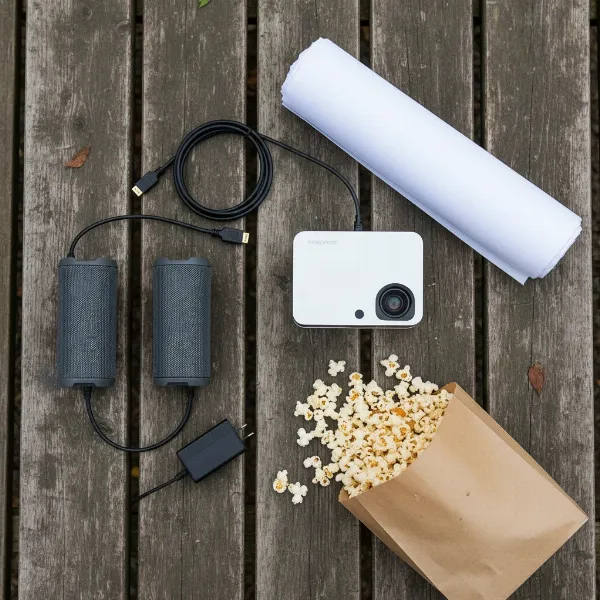 A collection of essential components for a DIY backyard theater, including a projector, a roll of white fabric, and portable speakers.
Tips for an Unforgettable Outdoor Movie Night
Once your DIY backyard theater is set up, a few extra tips can turn a good movie night into a truly memorable one.
- Choose the Right Location: Select the darkest spot in your backyard, away from direct streetlights or house lights. A flat, stable surface for your projector is crucial to maintain a clear image. Consider areas protected from strong winds if you have a freestanding screen.
- Optimal Viewing Time: For the best picture quality, wait until it’s completely dark. Even a powerful projector struggles against significant ambient light. Test your setup before guests arrive to adjust brightness and focus.
- Neighborly Considerations: Be mindful of your neighbors. Keep the volume at a reasonable level, especially late at night. Even better, invite them to join the fun! Consider using wireless headphones for a truly immersive experience without disturbing anyone.
- Weather Preparedness: Always have a backup plan in case of unexpected rain or high winds. A sudden downpour can quickly damage electronics. Have covers ready or be prepared to quickly move your gear indoors. Check the weather forecast beforehand.
- Maintenance for Longevity: Regularly clean your projector’s air filter to prevent overheating and ensure optimal performance. Store your projector and screen in a dry, safe place when not in use to protect them from the elements and prolong their lifespan.
- Bug Management: Outdoor evenings often come with uninvited guests. Use citronella candles, bug repellent sprays, or a small fan directed towards your seating area to keep mosquitoes and other insects at bay.
Conclusion
Building a DIY backyard theater on a budget is not just a dream—it’s an achievable and incredibly rewarding project. By carefully selecting a budget-friendly projector, embracing creative solutions for your screen and sound, and paying attention to setup details, you can transform your outdoor space into a captivating cinematic escape. From the crisp images to the immersive sound, every element comes together to create an experience that’s uniquely yours. So, gather your gear, invite your loved ones, and prepare for countless nights of unforgettable entertainment under the stars. What cinematic adventure will you embark on first?
Frequently Asked Questions
What’s the minimum projector brightness for outdoor use?
For a clear image after sunset in a very dark backyard, a projector with at least 2,000-2,500 lumens is recommended. If there’s any ambient light, or if you plan to start before it’s pitch black, aiming for 3,000 lumens or more will provide a significantly better viewing experience.
Can I use a white bed sheet as a projector screen?
Absolutely! A thick, king-size white bed sheet or a canvas drop cloth stretched taut can serve as an excellent budget-friendly projector screen. The key is to ensure it’s as flat and wrinkle-free as possible for the best image quality. You can use a DIY PVC pipe frame to achieve the necessary tension.
How can I get good sound quality on a budget for my outdoor theater?
Many budget projectors have built-in speakers, but for better immersion, consider external options. Portable Bluetooth speakers are an excellent and affordable choice, offering clear sound and easy wireless connectivity. Basic powered computer speakers can also be repurposed if you have them.
What about power and safety outdoors?
Safety is paramount. Always use outdoor-rated extension cords to connect your equipment to a power source. It’s highly recommended to plug all electronics into a multi-outlet power strip with surge protection to safeguard against electrical spikes. Keep all connections off the ground and away from potential moisture.
How do I protect my projector from the elements?
Projectors are not typically weather-resistant. It’s crucial to set up your outdoor theater only when good weather is certain. Always have a plan to quickly cover or move your projector and other electronics indoors in case of sudden rain, heavy dew, or strong winds. Store your projector in a dry, cool place when not in use.